VFX Course in Kochi | Curriculum & Career Guide
Choosing the right VFX course shapes the next several years of a creative career, which is why the format, the software, and the studio environment behind a course matter as much as the fee. Rays VFX Academy runs its VFX course in Kochi inside a working production environment connected to Rays3D, a studio with more than 12 years of production history. This guide covers the full 6 month, 400 hour curriculum, the tools taught, who the course suits, and the entry level roles graduates are prepared for, going well beyond the basic course and fee overview our earlier post covers.
Key Takeaways
- The course runs for 6 months across 400 hours and 6 structured modules, moving from digital design fundamentals to stereoscopic compositing.
- Training happens inside a real production environment connected to Rays3D rather than a classroom only setup, with access to Nuke, Mocha, Silhouette and Maya.
- Graduates are prepared for entry level VFX roles such as roto artist, compositor, matchmove artist and motion graphics artist.
What Rays VFX Academy’s VFX Course Covers: 6-Module, 400-Hour Curriculum Snapshot
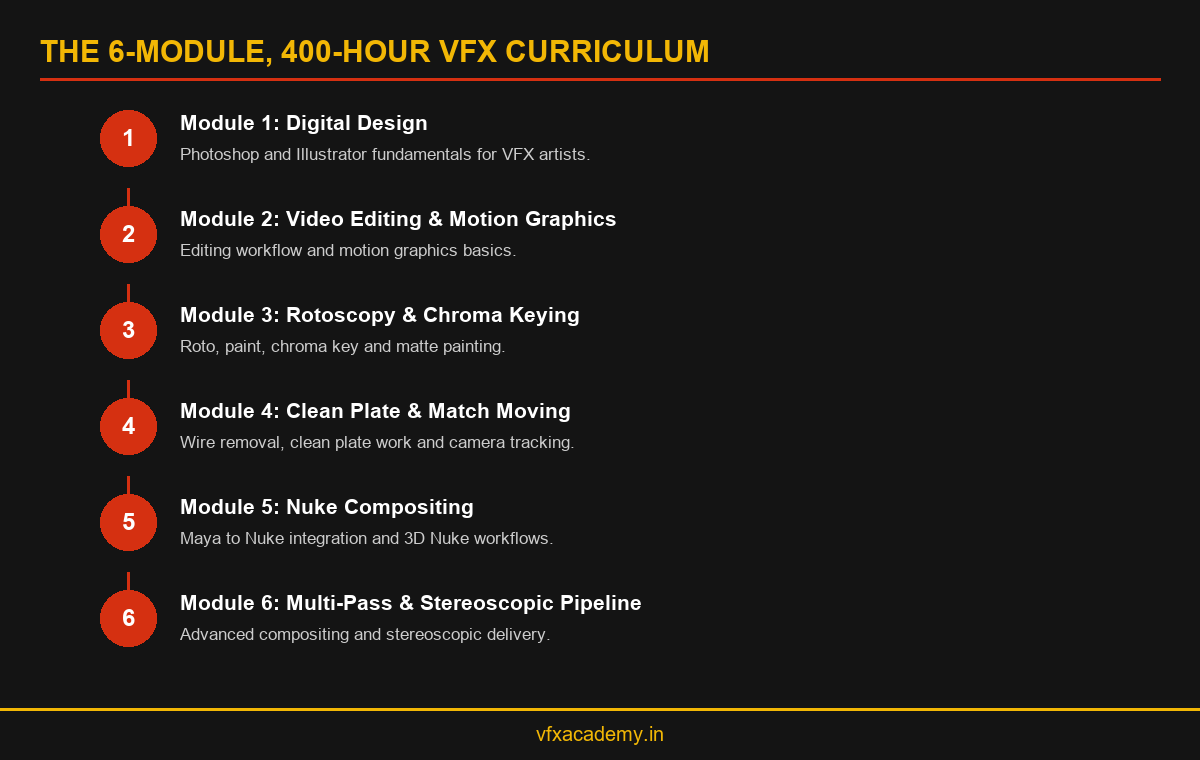
The flagship course is built as a 6 month, 400 hour program split across 6 modules that move from foundational design skills to full production compositing. Every module is designed to feed into the next, so a student who starts with digital design fundamentals is, by the final module, working on multi pass compositing and stereoscopic pipeline tasks similar to what a working studio handles. The sequence matters because visual effects work is layered. A compositor needs to understand roto and paint before touching camera tracking, and camera tracking needs to be solid before match moving and 3D integration make sense.
This structure is one reason the course is described as production ready rather than purely theoretical. Students are not handed six disconnected topics. They are walked through a pipeline that mirrors how a shot actually moves through a VFX studio, from raw footage to a finished, graded composite ready for delivery.
Each module also builds a small library of practical exercises that later becomes the backbone of a student’s showreel. Rather than a single final project at the end of six months, students accumulate shot level work throughout the course, which means the portfolio grows in step with the skills, module by module, instead of appearing all at once near graduation.
This module by module approach also gives instructors natural checkpoints to catch gaps early. A student who is still struggling with roto accuracy in module 3 can get targeted support before match moving and compositing pile additional complexity on top of an unresolved fundamental, which is a common reason students in weaker programs feel lost by the later stages of a course.
Foundation Modules: Design, Editing and Rotoscopy
The first three modules cover digital design fundamentals in Photoshop and Illustrator, video editing, and motion graphics, before moving into rotoscopy and chroma keying. These are the skills every entry level VFX artist uses daily, and they form the base for every module that follows. Matte painting also sits in this stage, giving students an early introduction to building believable digital environments before the course moves into camera work.
Production Modules: Tracking, Compositing and Stereoscopic Pipeline
The final three modules cover clean plate and wire removal, match moving and camera tracking, Nuke compositing, Maya to Nuke integration, 3D Nuke work, multi pass compositing and stereoscopic pipeline. This is where students move from single element fixes to assembling complete shots, which is the level of work expected in an entry level compositor or matchmove artist role. By the time a student reaches the stereoscopic pipeline unit, they are combining tracking data, 3D elements and multiple render passes into one delivery ready shot.
Studio-Backed Training Inside a Working Production Environment
Rays VFX Academy evolved from Rays3D, a working VFX and 3D production studio with more than 12 years of production experience, over 100 VFX and 3D projects released, and more than 5,000 artists trained. In 2015, the Kerala Government honoured the studio for its contribution to the self employment sector, and Rays3D also received the Lumiere Award for Technology recognition. These are studio credentials, not classroom credentials, and they shape how the course is taught.
Studio-backed training means students are learning inside an environment where production decisions, deadlines and client feedback are part of daily reality, not simulated for a classroom exercise. This is one of the clearest differences between a studio-backed academy and a generic multimedia institute, and it is worth understanding in detail before comparing options.
What 12 Years of Studio History Actually Changes
A studio that has run production work for over a decade has already solved the basic pipeline problems a newer institute is still working out: how shots move between artists, how review and feedback rounds are structured, and how a compositor hands work back to a supervisor. Students absorb these habits simply by training in the same environment, which is difficult to replicate in a lecture hall.
The Kerala Government honour and the Lumiere Award for Technology are also useful reference points for parents specifically, since they are third party recognition rather than marketing language written by the academy itself. Neither award is a substitute for evaluating the curriculum directly, but they do support the claim that Rays3D has an actual production track record behind the training.
What Studio Access Means for a Beginner
For a first time student, studio access does not mean working on client deliverables from day one. It means the instructors teaching rotoscopy or compositing are people who do this work professionally, so questions about why a shot is being approached a certain way get answered from production experience rather than from a textbook.
For a closer look at how to evaluate this difference when shortlisting institutes, see our guide on how to choose a VFX training institute in Kochi, which lays out specific questions to ask any academy, studio-backed or not, before you enrol.
For students based in Kochi and Ernakulam, this also means the studio and the classroom sit in the same city, which matters when a student wants to visit before enrolling, sit in on a live session, or simply see the equipment and workspace in person rather than relying on website photos alone. Local access is a small detail on paper, but it changes how confidently a family can evaluate a course before committing to it.
Who the Course Is For: After-12th Students, Career Changers, Self-Taught Creatives
The course is designed around three distinct starting points, and the teaching pace adjusts to each rather than forcing every student through an identical schedule regardless of prior experience. This matters because a one size fits all classroom pace either bores students with prior exposure or leaves complete beginners behind in the same room.
After-12th Students
Students who join right after 12th grade usually have creative interest but no formal design background, so the early modules spend more time on fundamentals before the pace picks up in the compositing stages. Parents evaluating the course for a child in this position tend to ask about structure and pacing more than software lists, and the module sequence is built to answer exactly that concern.
Early-Career, Self-Taught Creatives
Early-career creatives who already edit video or design graphics tend to move faster through the foundation modules and spend more time in Nuke, Mocha and Silhouette, since their gap is usually tool specific rather than conceptual. If this describes your starting point, our beginner’s roadmap to learning VFX from scratch walks through exactly what to expect in the first few weeks and how prior editing or design experience carries over.
Career Changers
The third group is career changers, often slightly older and evaluating VFX as a serious pivot rather than a first career. For this group, studio exposure and a clear view of entry level roles tend to matter more than course length, which is why career outcomes are covered in detail later in this guide, alongside an honest look at what job support does and does not include.
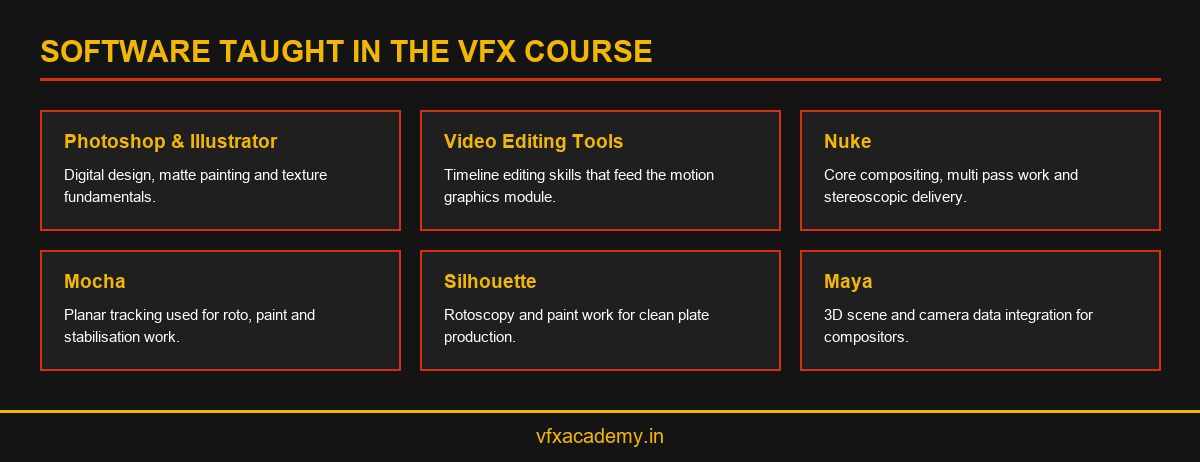
Tools and Software Taught: Photoshop, Illustrator, Nuke, Mocha, Silhouette, Maya
Software fluency is only useful when it is tied to a workflow, so each tool in the course is introduced at the stage where it is actually needed in production, not as an isolated lesson. This mirrors how tool skills are picked up inside a working studio, where a new hire learns a tool because a shot requires it, not because a syllabus lists it in isolation.
Design and Editing Tools
Photoshop and Illustrator are used for digital design fundamentals, matte painting and texture work. Video editing software supports the motion graphics module, giving students the editing vocabulary they need before moving into more specialised compositing tools later in the course. These early tools also teach file organisation and version discipline, habits that matter once shot counts grow in the later modules.
Compositing and 3D Integration Tools
The compositing modules centre on VFX compositing course training in Nuke, Mocha and Silhouette, which cover roto, paint, tracking and multi pass composites in detail.
Maya is introduced for 3D integration, so students understand how Maya scenes and camera data move into a Nuke composite. Students interested in how newer AI assisted tools fit into this same pipeline can read our separate breakdown of AI driven tools for 3D animation and VFX, which looks at where automation is genuinely useful in a production workflow and where it is not.
None of these tools are taught as a one time demo. Each one reappears across multiple modules in a slightly more advanced context, so a student’s second or third encounter with Nuke, for example, is already building on rotoscopy and tracking work done earlier in the course. This repetition is what turns software familiarity into working speed, which is closer to what a studio actually expects from a junior artist.
Format, Duration and Batch Structure: 6 Months, 400 Hours
The course runs across 6 months and 400 hours of structured, module based training. This length is intentional. VFX skills compound, and a shorter format tends to compress the compositing modules, which are exactly the modules that need the most practice time to become second nature.
Why 400 Hours Instead of a Short Weekend Program
A weekend or crash course format can introduce software menus, but it rarely leaves enough repetition time for roto, tracking or compositing to become reliable under time pressure, which is what studio work actually demands. The 400 hour structure exists to give each module enough practice time that a graduate can move at production pace, not just recognise the tools.
It also allows instructors to reintroduce a tool in a harder context rather than a single pass. Mocha, for example, appears first for basic planar tracking and later again for tracking work that feeds directly into a compositing shot, which is a very different level of accuracy demand. That second pass is only possible because the course length allows time to circle back.
For a full breakdown of how the batch structure, weekly hours and module pacing actually work day to day, see VFX classes explained: format, duration and what you’ll actually learn, which expands on the scheduling side of the course in more detail than this overview.
Batch sizes are also kept small enough that instructors can review individual shot work rather than only presenting to the room, since compositing and roto work is easiest to correct with direct, shot specific feedback. Prospective students should always confirm current batch size and timing directly, since these details can shift between intakes.
AIS/Hollywood-Associated Certification
Rays VFX Academy positions its course with an AIS and Hollywood associated certification, presented by the academy as a differentiator against generic multimedia institutes. As with any certification claim in a competitive education market, prospective students and parents are right to ask what the certification actually covers before enrolling.
What to Ask Before Treating Any Certification as Proof
A useful habit when comparing any VFX institute, including this one, is to ask what the certifying body actually evaluates, whether it is tied to a specific module or the full course, and how it is presented on a final certificate. Asking these questions is a sign of a serious student, not scepticism for its own sake, and any credible academy should be able to answer them directly.
We have written a dedicated explainer on what the AIS Hollywood-certified animation academy positioning covers, which is the right place to look for a closer look at how to evaluate this claim. It is also worth understanding the practical difference between a diploma track and a certificate track, covered in VFX diploma vs VFX certificate, since certification format affects how the credential is recognised later by employers and by other institutions.
In practice, this means asking to see how the certification is worded on the final certificate itself, whether it names AIS directly, and whether the academy can point to the specific association rather than a general reference. A studio backed academy with a genuine production history, named recognition such as the Lumiere Award, and a transparent answer to these questions is easier to evaluate than one relying on certification language alone.
Career Outcomes and Entry-Level VFX Roles
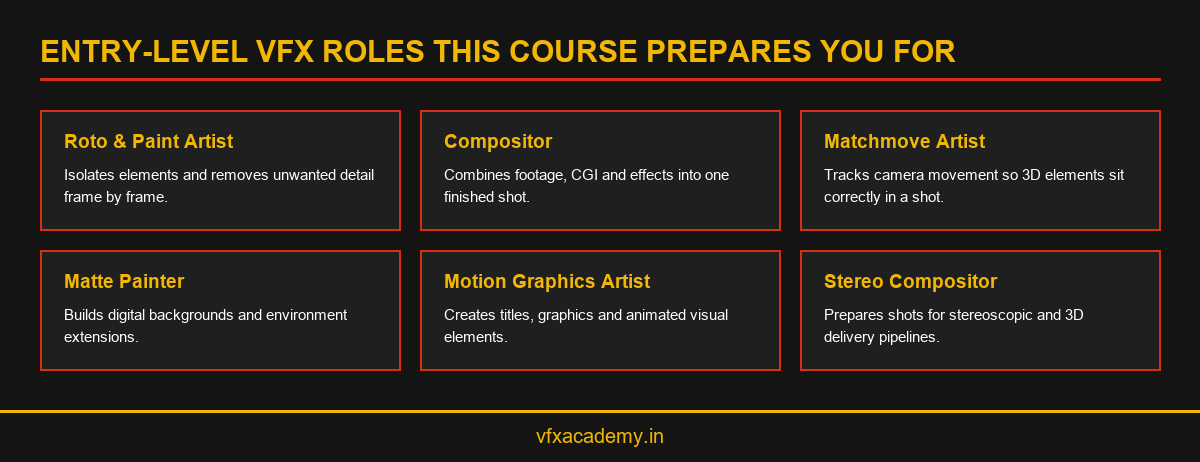
The course maps directly onto a set of entry level VFX roles that studios actively hire for: roto and paint artist, compositor, matchmove artist, matte painter and motion graphics artist. For a fuller view of how these roles fit into a longer VFX career path, our post on top career opportunities in VFX lays out the wider landscape beyond entry level positions, including where a career can head after the first few years.
Matching Modules to Job Titles
Students who want a deeper, tool by tool look at which skills map to which job title should read VFX artist course: skills, software and career roles you’ll be ready for, which breaks the roto artist, compositor and matchmove artist roles down individually and shows which modules build each skill set.
Being Honest About What a Course Can Promise
It is worth being direct about one thing here. No serious VFX course, including this one, can promise a specific placement outcome or a fixed starting salary, and any institute that claims otherwise deserves extra scrutiny. What a studio-backed course can offer is production relevant skills, a portfolio built on real workflows, and studio proximity through Rays3D that a classroom-only institute cannot match.
Career growth in VFX rarely stops at the entry level title. Artists who spend a few years as a roto artist or junior compositor typically move toward senior compositing, lead roles on a sequence, or a specialisation such as stereoscopic work or matte painting supervision. The entry level roles this course targets are a starting point, and the skills built in the later modules, particularly multi pass compositing, are what make that next step realistic.
Free Demo Class and Admission Process
Rays VFX Academy offers a free demo class before admission, which is worth using regardless of how confident you already are about the course. It is the fastest way to see the studio environment, meet instructors, and get a direct answer on batch timing. Full course details, including how the demo class connects to enrolment, are on the official VFX course page.
What Happens During the Free Demo Class
A demo class typically walks through a short hands on exercise, a look at the studio space, and a conversation about current batch timing and eligibility. It is also the easiest way to meet an instructor and ask specific questions about pacing if you are unsure whether the course fits your starting point.
Fees are a common concern for students and parents comparing institutes, and it is a fair one. Our explainer on zero upfront fee VFX courses and how payment plans work sets honest expectations on what fee deferral and scholarship style options typically involve, without overpromising. Once fees and format both make sense, the comparison between visual effects colleges and studio-backed VFX academies is a useful last step before you decide.
Parents attending the demo class alongside a student are welcome, and it is often the most useful way to get direct answers on batch timing, fee structure and studio access in one visit rather than piecing information together from a website. Bringing specific questions from this guide, including ones about certification and career outcomes, tends to make that conversation more productive.
Conclusion
A VFX course is only as strong as the pipeline it teaches and the studio access behind it. Rays VFX Academy’s 6 month, 400 hour course in Kochi is built around a real production pipeline, from foundation design skills through to stereoscopic compositing, with studio access through Rays3D throughout. If you are ready to see the training environment for yourself, book a free demo class or reach out on WhatsApp at +91 88488 88906 to check current batch availability.
Frequently Asked Questions
What is the duration of the VFX course at Rays VFX Academy?
The flagship VFX course runs for 6 months across 400 hours, split into 6 modules that move from design fundamentals through to stereoscopic compositing, matching the structure used in a working production pipeline.
Is the VFX course in Kochi suitable for students with no design background?
Yes. The course begins with digital design fundamentals in Photoshop and Illustrator before moving into rotoscopy and compositing, so students starting right after 12th grade are guided from the basics upward.
What software will I learn during the VFX course?
Students train in Photoshop, Illustrator, Nuke, Mocha, Silhouette and Maya, applied across rotoscopy, tracking, compositing and 3D integration modules that mirror an actual studio pipeline.
Does the course include real studio experience?
Training takes place inside a production environment connected to Rays3D, a studio with over 12 years of experience and 100 plus VFX and 3D projects, rather than a classroom-only setup.
What does the AIS/Hollywood-associated certification actually cover?
It is the academy’s stated positioning around external credibility and certification. Prospective students should review the certification explainer on our homepage before treating it as an independently verified credential.
What job roles can I apply for after completing the VFX course?
Graduates typically target entry level roles such as roto artist, compositor, matchmove artist, matte painter and motion graphics artist, based on the modules and software covered in the course.
Is there a free demo class before I enroll?
Yes, Rays VFX Academy offers a free demo class so prospective students can see the studio environment and meet instructors before committing to admission.
How is this course different from a generic multimedia course?
The course is VFX specific and studio backed through Rays3D, rather than covering VFX as one small unit inside a broader multimedia or animation syllabus.
Can I join the VFX course after 12th grade with no portfolio?
Yes. Most students join directly after 12th grade with no prior portfolio. The early modules are designed to build foundational design and editing skills before compositing work begins.
How does this VFX course compare to a 3D animation course?
This course focuses on VFX and compositing. Students who also want modelling, rigging and animation depth should compare it against our 3D animation course and diploma guide to see which path fits their goals.

You may also like
Diploma in 3D Animation: Full Curriculum Breakdown
3D Animation Design: Skills, Software, and Tools You’ll Master