Diploma in Animation: Programs, Duration, and Career Scope
A diploma in animation is one of the most searched entry points into a creative career in India, but the term covers a wide range of programs that differ enormously in duration, depth, and outcome. Some run for years and cover unrelated multimedia subjects, while others compress focused, production-ready training into a few months. This guide compares what these programs actually offer and shows where Rays VFX Academy’s studio-backed course fits for students who want production-ready skills rather than a broad, generic multimedia syllabus.
Key Takeaways
- A diploma in animation typically runs one to three years and covers animation as part of a wider multimedia curriculum.
- Duration alone does not indicate quality. How the hours are spent, on theory versus guided production practice, matters more.
- Career scope after a diploma depends heavily on whether the training connected software skills to a real production pipeline.
What Diploma in Animation Actually Means in India
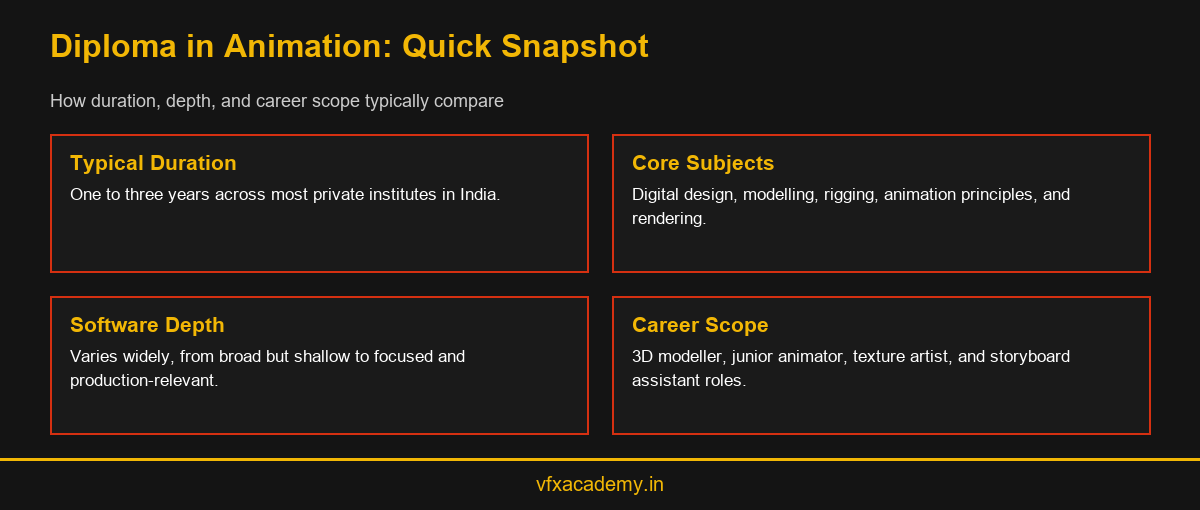
In the Indian education market, a diploma in animation is typically offered by private multimedia institutes rather than government universities, and program length varies widely from one year to three years depending on the institute. Because there is no single national standard defining what a diploma must include, two institutes offering the same title can teach very different content, one may lean heavily into 2D animation and storytelling, while another focuses almost entirely on 3D modelling and rendering software.
This inconsistency is exactly why prospective students need to look past the word diploma and ask for the actual module breakdown before enrolling anywhere. A detailed syllabus, hour by hour, tells you far more than a program’s marketing title ever will.
Parents researching this decision on behalf of a child often assume the word diploma implies a regulated, standardised qualification similar to a government polytechnic diploma. In reality, most animation diplomas are private certifications issued directly by the institute itself. This is not necessarily a problem, since employers in this field weigh a portfolio far more heavily than the credential’s formal status, but it does mean families should verify claims independently rather than assuming a diploma guarantees a fixed standard across every provider.
This is also why search terms like diploma in animation and diploma of animation return such a mixed range of results, spanning government polytechnics, private multimedia chains, and focused studio-backed courses side by side. Treat the search results as a starting list to investigate, not a ranked recommendation, and spend your early research time reading actual curriculum documents rather than comparing headline durations.
Programs Compared: Duration, Structure, and What You Actually Learn
Most diploma in animation programs fall into three rough bands. Shorter one-year programs usually cover fundamentals only, often without enough hours for genuine production practice. Two-year programs add more software depth and sometimes an internship component. Three-year programs, closer to a degree in structure, cover animation alongside broader design or multimedia subjects that may dilute the time spent specifically on 3D or VFX skills.
Rays VFX Academy’s course takes a different structural approach entirely. Rather than stretching training across years to cover unrelated subjects, it concentrates 400 hours across 6 months into modules that connect directly to a working VFX and animation pipeline, from digital design fundamentals through to Maya-Nuke integration. For a full breakdown of how this curriculum is sequenced, see Diploma in 3D Animation: Full Curriculum Breakdown.
When comparing structure across programs, ask specifically how many hours are spent on guided, hands-on production work versus lecture-style theory. A three-year diploma that dedicates only a few hundred hours to genuine 3D production practice can leave a student less prepared than a shorter course built entirely around applied studio work. Total duration on a brochure rarely reflects this distinction, which is why asking for a week by week hour breakdown before enrolling matters more than comparing program length alone.
Career Scope After a Diploma in Animation
Career scope after any diploma in animation depends less on the diploma’s length and more on whether training connected directly to production practice. Entry-level roles commonly reached after a diploma include 3D modeller, junior animator, texture artist, and storyboard assistant, roles that value a demonstrable portfolio far more than the number of years listed on a certificate.
India’s animation and VFX sector has grown steadily alongside the wider technology and media industry tracked by bodies such as NASSCOM, creating demand for artists who can move between animation and post-production tasks. For a broader view of roles across the industry, see Top 10 Career Opportunities in VFX.
Career growth after the first entry-level role typically depends on the strength of an artist’s portfolio and their ability to work reliably inside a studio pipeline, rather than the diploma title itself. Artists who understand how their work connects to the next stage of production, for example how a model needs to be built for a rigger to use it efficiently, tend to progress faster than those who learned software in isolation without this broader context.
Where Rays VFX Academy’s Course Fits Into This Picture
Students who compare a traditional diploma against Rays VFX Academy’s course are really comparing two different philosophies, broad multi-year coverage versus a focused, studio-backed track. Rays VFX Academy evolved from Rays3D, a production studio with 12+ years of experience and 5,000+ artists trained, and this lineage shapes how the course is taught, with instructors who work inside the same pipeline they teach.
For students still deciding between a broader diploma and a focused course, our full 3D Animation Course and Diploma guide compares curriculum depth, software coverage, and career outcomes across formats in more detail. Students weighing this decision straight after 12th grade may also want to read how eligibility works for Diploma in Animation After 10th, since entry requirements differ across institutes.
Rays3D’s recognition, including a Kerala Government honour in 2015 for its contribution to the self-employment sector and a Lumiere Award for Technology, gives families a way to verify claims independently rather than relying on marketing language alone. The course also carries AIS/Hollywood-associated certification as a stated positioning point, which students can raise directly with the academy during a free demo class before enrolling.
Questions to Ask Before Choosing a Diploma Program
Before signing up for any diploma in animation, ask the institute for a week by week module breakdown rather than a general course description. Ask how many hours are dedicated to hands-on production work in software like Maya, and how many are spent on general theory or subjects unrelated to your specific career goal. Ask whether instructors currently work on production projects, since active practitioners tend to teach workflows that match what studios actually expect from a junior artist today.
Also ask to see finished student work, not promotional showreels produced by the institute itself. A student’s raw, unedited reel tells you far more about what a typical graduate can actually produce than a highlight reel curated for marketing. Finally, ask directly about batch size, campus access, and whether a free demo class is available, since sitting in on an actual session is the clearest way to judge fit before committing time and money to any program.
One more question worth asking directly is how the program handles the handoff between animation and any adjacent post-production work, since this is where many diploma programs leave a visible gap. If compositing, rendering standards, or delivery formats are treated as someone else’s problem, graduates often struggle to understand why a shot gets rejected once it reaches a later stage of production.
Conclusion
A diploma in animation is not a single, standard product. Duration, structure, and career outcomes vary widely across institutes, and the number of years on a certificate says less than the hours spent on real production practice. Rays VFX Academy’s studio-backed course offers a focused alternative built on real production history. Book a free demo class to see how the curriculum works before you commit to any program.
Frequently Asked Questions
How long does a diploma in animation usually take?
Most diploma in animation programs in India run one to three years, though duration varies by institute. Focused certificate-style courses, like Rays VFX Academy’s, can cover comparable depth in 6 months across 400 hours.
Is a diploma in animation better than a short certificate course?
Neither format is automatically better. What matters is whether the hours are spent on guided production practice connected to a real pipeline, rather than the total duration alone.
What subjects are covered in a diploma in animation?
Typical subjects include digital design, modelling, rigging, animation principles, and rendering. Some programs also cover 2D animation, storyboarding, and post-production basics.
Can I get a job with just a diploma in animation?
Yes, many entry-level roles such as junior animator or 3D modeller are open to diploma holders, though employers weigh a candidate’s portfolio heavily alongside their certificate.
Does Rays VFX Academy offer a diploma in animation?
Rays VFX Academy’s flagship program is a 6-month, 400-hour VFX course that includes 3D animation training, structured as a focused, studio-backed alternative to a traditional multi-year diploma.
What is the difference between a diploma in animation and a diploma in 3D animation?
A diploma in animation may include 2D and general multimedia subjects, while a diploma in 3D animation focuses specifically on 3D modelling, rigging, and rendering skills.
Do I need a diploma before joining a VFX course?
No. Many students join a VFX or 3D animation course directly after school without a prior diploma, since structured courses typically start from fundamentals.
How do I compare animation diploma programs before enrolling?
Ask for a detailed, hour by hour syllabus, confirm which software is taught in depth, and check whether instructors currently work in production. See 3D Animation Courses for Beginners for a beginner-focused comparison approach.

You may also like
Diploma in 3D Animation: Full Curriculum Breakdown
3D Animation Design: Skills, Software, and Tools You’ll Master