VFX Diploma vs VFX Certificate: What’s the Difference
Most students researching a VFX diploma run into two overlapping terms almost immediately: diploma and certificate. The words get used loosely across institute websites, which makes comparison harder than it should be. This guide breaks down what each term actually means, where Rays VFX Academy’s 6 month, 400 hour course fits, and how to decide which path suits your situation.
Key Takeaways
- A diploma generally signals a longer, structured program with broader curriculum depth, while a certificate often points to a shorter, narrower skill focus.
- What matters more than the label is the actual hours, module depth and studio access behind the course.
- Rays VFX Academy’s 6 month, 400 hour course is structured with diploma level depth across 6 production modules.
Diploma vs Certificate: What Each Term Actually Means
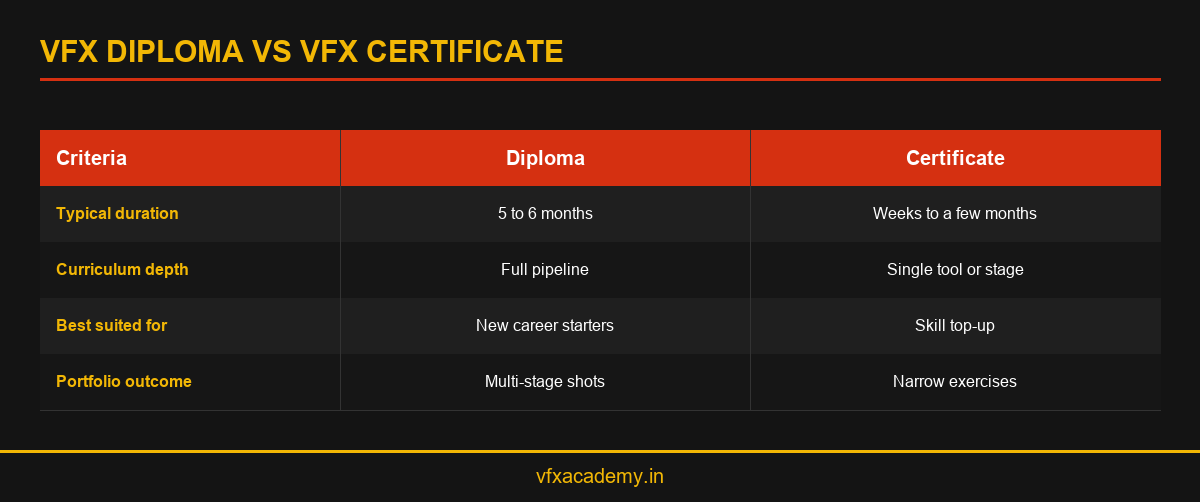
In visual effects education, a diploma usually refers to a longer program, often 6 months or more, covering a full pipeline from fundamentals through to advanced production skills. A certificate is more often used for shorter, narrower training, sometimes a single tool or a single stage of the pipeline, such as a roto and paint certificate or a Nuke basics certificate.
Neither term is strictly regulated across the VFX training industry in India, which is exactly why the label alone should never be the deciding factor. Two institutes can call very different programs a diploma. What actually determines value is the hour count, the module breakdown, and whether the training happens inside a real production environment or a purely classroom setting.
There is also a practical difference in how each credential reads to an employer later. A diploma signals that a candidate has been exposed to the full shot pipeline, from rotoscopy through to final composite, while a certificate signals a narrower, specific skill. Neither is automatically better, but they answer different questions on a resume, and mixing them up during your course search can lead to comparing programs that are not actually equivalent.
A useful test when reading any institute’s website is to check whether the program describes itself around a full pipeline arc, from fundamentals to a finished composite, or around a single skill block. The first pattern almost always points to genuine diploma depth, while the second, even if labelled a diploma, is closer in substance to a certificate.
Where Rays VFX Academy’s Course Fits: A 6-Month, 400-Hour Structure
Rays VFX Academy’s flagship course runs 6 months across 400 hours and 6 modules, from digital design fundamentals through rotoscopy, match moving, Nuke compositing and stereoscopic pipeline. This puts it firmly on the diploma end of the spectrum in terms of depth and duration, even though the academy also emphasises certification value through its AIS and Hollywood associated positioning.
The distinction matters practically. A student choosing between a 6 week certificate in Nuke basics and a 6 month structured course is not really choosing between two versions of the same thing. They are choosing between a narrow tool introduction and a full pipeline education that ends with a portfolio built across multiple stages of production work.
For the exact weekly structure and batch pacing behind this 6 month format, see VFX classes explained: format, duration and what you’ll actually learn, which covers the scheduling side in more detail than this comparison.
It is also worth noting that a course can carry diploma level depth while still using certificate language in its marketing, or the reverse. This is exactly why the module count and hour total matter more than which word appears on the homepage. A 6 module, 400 hour structure with a full pipeline arc is a diploma in substance, whatever term sits on the certificate itself.
Which One Should You Choose
If your goal is a full entry level VFX career, roto artist, compositor, matchmove artist or similar, a diploma length program is almost always the safer choice, because these roles require depth across multiple pipeline stages, not a single tool skill. A narrow certificate can leave real gaps that show up quickly once you are working on an actual production shot.
A shorter certificate can make sense in a specific case: a working professional who already has broad VFX experience and only needs to add one missing tool skill, such as Mocha tracking, to their existing capability. For a first time student building a career from scratch, that is rarely the right starting point.
Students weighing this decision alongside parents often find it useful to separate two questions: what credential looks best on paper, and what training actually builds a hireable skill set. The second question should carry more weight. A compact certificate might look efficient, but if it skips tracking, compositing or stereoscopic work entirely, the resulting portfolio will show that gap to anyone reviewing it closely.
There is one more angle worth considering before enrolling: how much of the training is hands on versus lecture based. A diploma length course only delivers its full value if the extra hours translate into extra practice time on real shots, not additional lecture content covering the same fundamentals at a slower pace.
What to Verify Before You Enrol, Diploma or Certificate
Regardless of which label an institute uses, ask for the actual hour count, the full module list, and whether training happens inside a working studio or a classroom only setup. India does not have a single regulator specific to private VFX diplomas the way AICTE governs recognised technical diploma standards more broadly, so due diligence sits with the student and family, not a single approval stamp.
If you are comparing this course against other diploma style 3D animation programs, our explainer on what to verify in a certified 3D animation diploma program walks through the same verification questions from an animation specific angle, which is useful if you are also weighing a combined VFX and animation path.
It is also reasonable to ask how a certificate or diploma is issued, whether it lists specific modules completed, and whether the institute can show examples of student portfolio work produced during the course. An institute confident in its training is usually happy to share this. One that is vague about specifics deserves more questions, not fewer.
Cost and Value: Comparing Diploma and Certificate Pricing
Diploma length programs typically cost more upfront than short certificates simply because they cover more instructional hours and studio time. When comparing pricing across institutes, it helps to look at cost per hour of actual training rather than the headline course fee alone, since a cheaper short certificate can end up costing more per hour of real skill building.
It also helps to ask what happens after the course fee is paid. Some institutes bundle studio access, portfolio review sessions and demo class follow up into the price, while others charge separately for anything beyond the core module list. Getting this in writing before enrolling avoids surprises later, regardless of whether you choose a diploma or a certificate path.
Fee structure is a fair concern for most families evaluating this decision, and it should not be brushed aside. Our explainer on zero upfront fee VFX courses and how payment plans work sets realistic expectations on what fee deferral options typically involve, and our guide on how to choose a VFX training institute in Kochi covers the full set of questions worth asking, cost included, before signing up for either path.
Conclusion
A VFX diploma and a VFX certificate serve different goals, and the label matters far less than the hours, modules and studio access behind it. Rays VFX Academy’s 6 month, 400 hour course is built with diploma level depth across a full production pipeline. Explore the complete curriculum in our VFX course in Kochi guide, or book a free demo class to see the studio environment for yourself.
Frequently Asked Questions
Is a VFX diploma better than a VFX certificate?
For a first career, a diploma is usually better because it covers the full pipeline. A certificate can suit someone adding one specific skill to existing VFX experience.
How long does a VFX diploma course usually take?
Most structured VFX diploma programs run 5 to 6 months. Rays VFX Academy’s course runs 6 months across 400 hours and 6 production modules.
Does Rays VFX Academy offer a diploma or a certificate?
The course is structured with diploma level depth and duration, while also carrying the academy’s stated AIS and Hollywood associated certification positioning.
What should I check before choosing any VFX diploma course?
Confirm total hours, the full module list, whether training happens inside a working studio, and how the certificate or diploma is worded on completion.
Can I get a VFX job with just a short certificate?
It is possible for a narrow, tool specific role, but most entry level VFX roles expect broader pipeline exposure than a short certificate typically covers.
Is a VFX diploma recognised the same way as a college degree?
No. A VFX diploma from a private institute is a skills credential, not a university degree. Employers evaluate it primarily through your portfolio and demo reel rather than the credential alone.
What is the difference between a VFX diploma and a 3D animation diploma?
A VFX diploma focuses on compositing, tracking and effects work, while a 3D animation diploma centres on modelling, rigging and animation, though many students study both.
Should I choose a diploma if I am switching careers into VFX?
Yes, in most cases. Career changers benefit from the broader pipeline exposure a diploma length program provides, rather than a narrow single tool certificate.

You may also like
Diploma in 3D Animation: Full Curriculum Breakdown
3D Animation Design: Skills, Software, and Tools You’ll Master