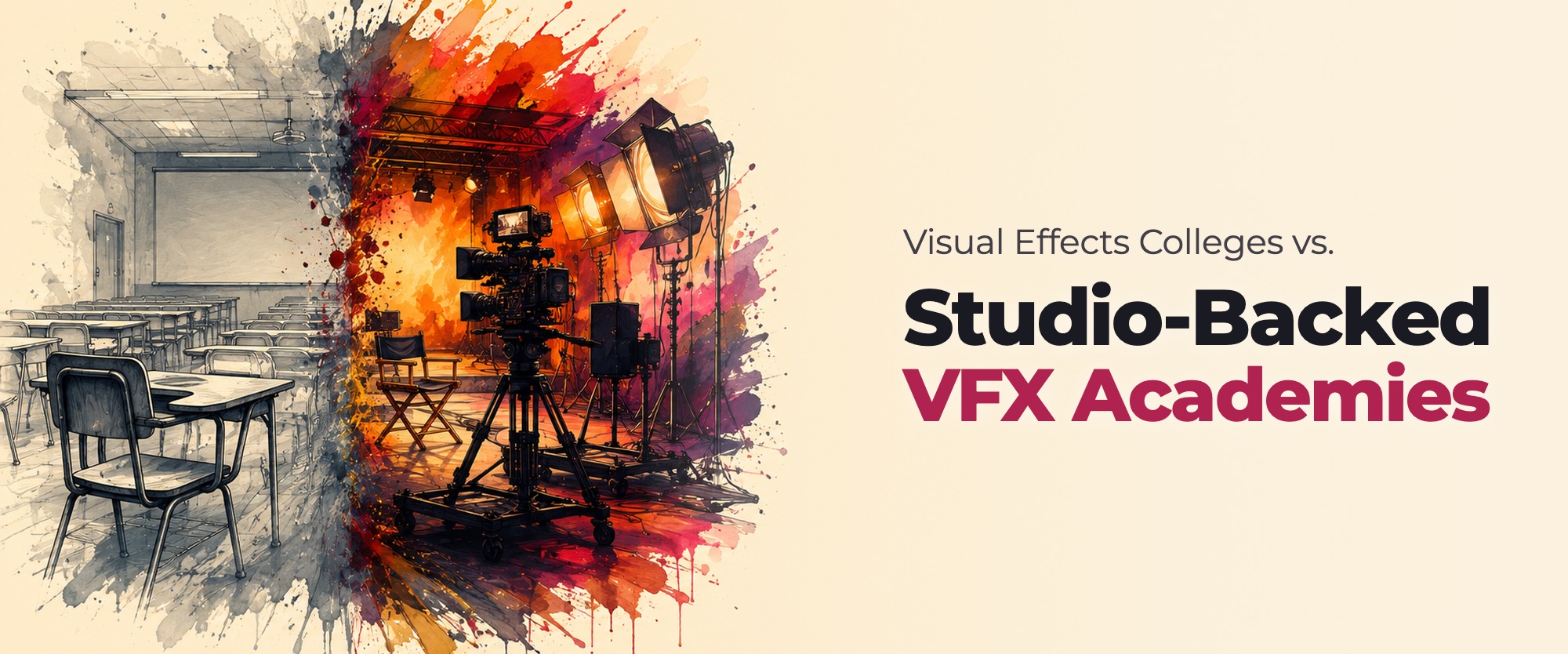
Visual Effects Colleges vs. Studio-Backed VFX Academies
Searching for visual effects colleges usually turns up two very different kinds of results: multi-year degree programs inside larger colleges, and shorter, focused academies connected to an actual production studio. Both can teach visual effects skills, but the training environment, and what you leave with, differs more than most comparison pages admit.
Key Takeaways
- Visual effects colleges typically offer broader, longer degree programs; studio-backed academies focus tightly on production-ready VFX skills.
- The biggest practical difference is access: a working studio pipeline versus a classroom-only setup.
- Rays VFX Academy positions itself as studio-backed through its connection to Rays3D, a working production studio.
How Visual Effects Colleges Typically Structure Training
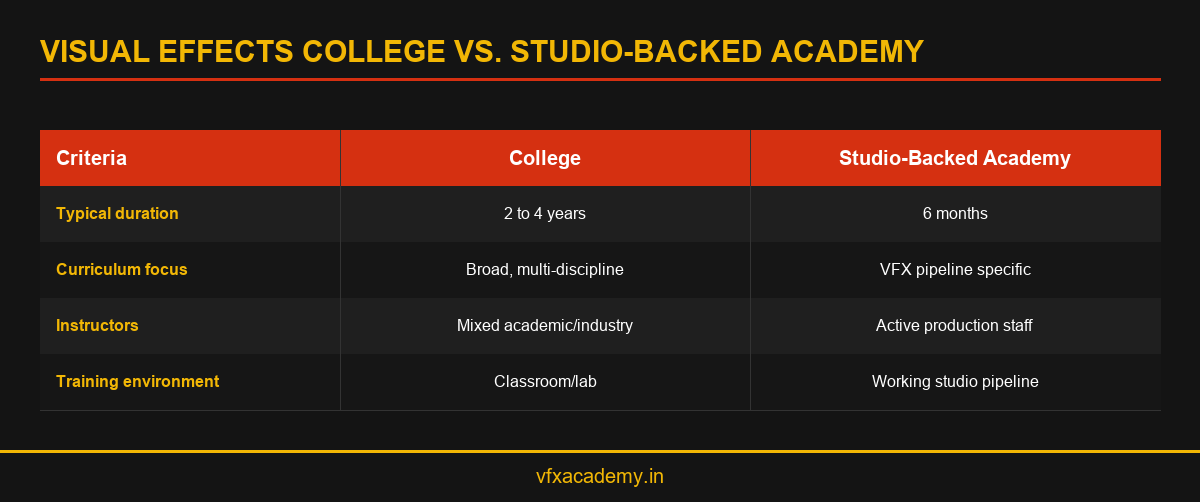
A traditional visual effects college often runs as part of a broader design, media or fine arts degree, spanning two to four years. The curriculum tends to be wide, covering animation, game design, film theory and VFX as one specialisation among several. That breadth has real value for students who aren’t sure yet which creative direction they want, but it also means less concentrated time on VFX-specific production skills.
Instruction in this setting is usually delivered by academic faculty, some of whom have industry experience and some of whom do not. Facilities vary widely by institution, and access to a genuinely active production pipeline, rather than a lab environment built for teaching, is not guaranteed.
How Studio-Backed VFX Academies Are Different
A studio-backed academy inverts that model: a shorter, focused program built specifically around one pipeline, taught by people who work in that pipeline. Rays VFX Academy’s 6-month, 400-hour course runs inside the Rays3D production environment, a studio with over 12 years of production history and industry recognition including a Lumiere Award for Technology. That connection changes what students are exposed to day to day: real production footage, active instructor feedback, and a pipeline built around delivering finished work, not just passing assignments.
This doesn’t automatically make a studio-backed academy "better" in every sense. It makes it different, more concentrated, more production-specific, and generally faster to complete. Students deciding between the two paths are really choosing between breadth and depth.
How to Evaluate Either Option Honestly
Regardless of which type of institute you’re comparing, ask the same core questions: who is teaching you, what real production work have they done, and can you see the training environment in person. Bodies like the Visual Effects Society exist to represent the industry broadly, but they don’t certify individual schools, so due diligence on any specific college or academy sits with the student and family. Our guide on how to choose a VFX training institute in Kochi covers the full set of verification questions worth asking either type of institute.
If your priority is breadth and you’re not yet certain VFX is your final direction, a college-style program may suit you better. If you already know you want production-ready VFX skills in the shortest realistic timeline, a studio-backed academy is built for exactly that goal.
Conclusion
Visual effects colleges and studio-backed academies solve different problems: breadth versus depth, years versus months, classroom versus working pipeline. Rays VFX Academy’s studio-backed model through Rays3D is built for students who already know they want production-ready VFX skills. Explore the full course structure in our VFX course in Kochi guide, or book a free demo class to see the studio environment directly.
Frequently Asked Questions
Is a studio-backed VFX academy better than a college?
Neither is universally better. Colleges suit students wanting broader creative exposure over several years; studio-backed academies suit students who already want focused, production-ready VFX skills faster.
How long does a visual effects college program usually take?
Typically 2 to 4 years as part of a broader design or media degree, compared to Rays VFX Academy’s 6-month, 400-hour focused course.
What makes a VFX academy "studio-backed"?
It means the training happens inside or alongside an active production studio, with instructors who currently do production work, rather than in a classroom disconnected from real projects.
Can I switch from a college program into a studio-backed academy later?
Yes, many students use broader college training as a foundation and later pursue focused, studio-backed training to build production-ready skills.
Does Rays VFX Academy offer a degree?
No. It offers a focused 6-month, 400-hour skills-based course connected to Rays3D’s production pipeline, not a multi-year academic degree.

You may also like
Diploma in 3D Animation: Full Curriculum Breakdown
3D Animation Design: Skills, Software, and Tools You’ll Master