
Learn VFX From Scratch: A Beginner’s Roadmap
Wanting to learn VFX from zero experience is a completely normal starting point, and most working VFX artists started exactly there. What actually separates a smooth start from a frustrating one is a clear sequence to follow instead of jumping between random tutorials. This roadmap lays out that sequence step by step, and points out where structured, studio backed training changes the outcome.
Key Takeaways
- VFX skills build in a specific order, design basics, then rotoscopy, then tracking, then compositing, and skipping the order creates gaps later.
- Self-taught learning can cover early fundamentals, but tracking and compositing are much harder to learn well without feedback and studio context.
- A structured, 6 month course compresses a path that can otherwise take years of inconsistent, self-directed learning.
Why Learning VFX Means More Than Watching Tutorials
Free tutorials are genuinely useful for a first look at visual effects software, but they tend to teach isolated tricks rather than a repeatable workflow. A student can follow ten tutorials on ten different effects and still struggle to complete one full shot independently, because tutorials rarely explain how the steps connect into a pipeline.
This is the single biggest gap self-taught beginners run into. They can often reproduce a specific result shown on screen, but cannot yet diagnose why a shot is not working when something goes wrong, because they never learned the underlying logic, only the click sequence for one example.
The fix is not to avoid tutorials entirely. It is to treat them as a supplement to a sequence, not the sequence itself. A beginner following a clear order, design basics, then roto, then tracking, then compositing, can still use tutorials productively at each stage, because each tutorial now reinforces a skill that is already being built in order rather than introducing a random, disconnected trick.
Setting a realistic weekly practice rhythm also matters more than most beginners expect. Short, frequent practice sessions on the same skill build muscle memory faster than long, irregular sessions, particularly for detail heavy work like rotoscopy where consistency of hand and eye matters as much as understanding the tool.
Beginners often ask whether a laptop is powerful enough to start, and for the early design and editing stages, most reasonably modern machines handle the workload fine. Tracking and compositing software become more demanding later, which is one more reason structured programs that provide lab or studio access remove a real barrier that self-taught learners have to solve on their own.
Steps 1 to 3: Build Design, Editing and Roto Fundamentals
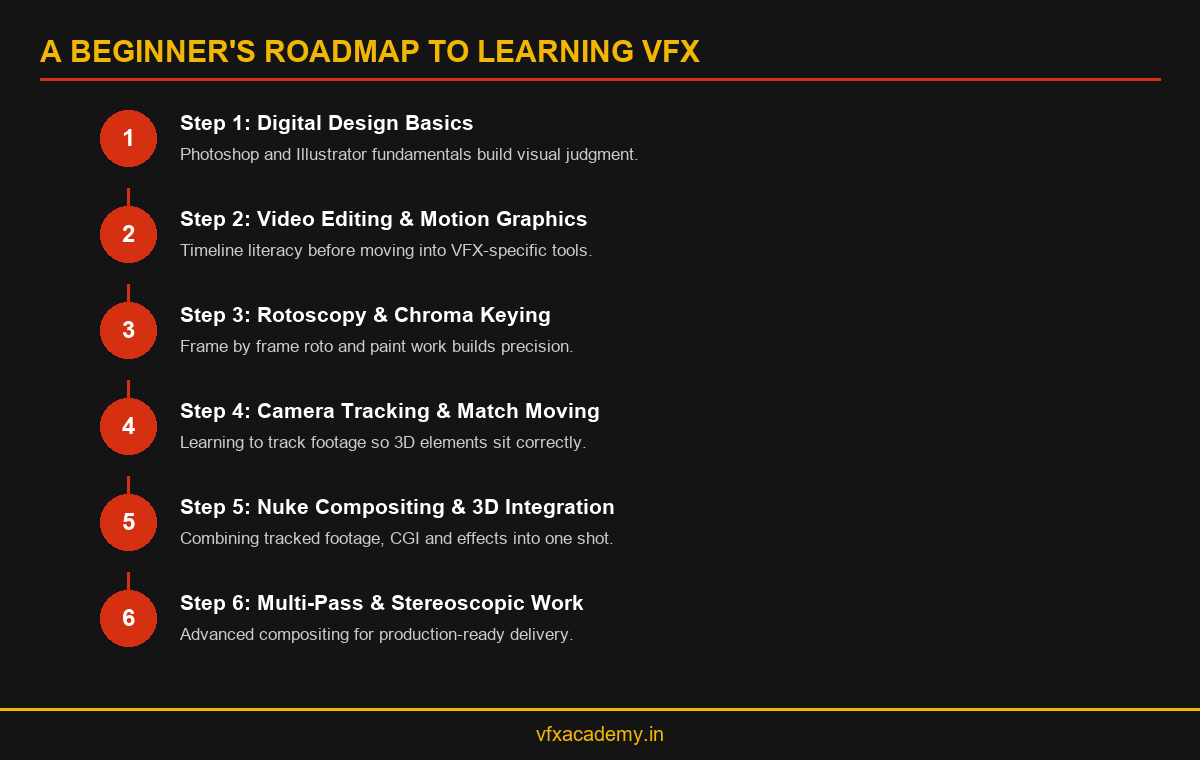
The first real step is not VFX software at all. It is basic digital design in tools like Photoshop and Illustrator, which builds the visual judgment every later step depends on. Skipping straight to compositing software without this foundation is one of the most common reasons beginners plateau early.
From there, video editing and motion graphics give a beginner the timeline literacy needed before rotoscopy and chroma keying, which are usually the first true VFX skills a student practices. Roto work is slow and detail heavy, and it is also the fastest way to build the frame by frame patience that later compositing work demands.
It is worth spending real time here rather than rushing toward compositing software. A beginner who can roto a moving subject cleanly, frame after frame, has already built the patience and precision that camera tracking and later compositing both require. Skipping ahead before this feels comfortable tends to show up as sloppy, uneven work several steps later.
Steps 4 to 6: Move Into Tracking, Compositing and a Real Pipeline
Once roto and chroma key feel comfortable, the next stage is camera tracking and match moving, followed by compositing in Nuke and 3D integration through Maya. This is where the pipeline stops being a set of separate skills and starts being one connected workflow, and it is also where self-taught learners most often stall.
Camera tracking in particular punishes guesswork. A track that looks fine at a glance can drift noticeably once a 3D element is placed into the shot, and catching that drift takes trained eyes, not just software familiarity. This is one of the clearest points in the roadmap where structured feedback saves weeks of frustrated trial and error.
Compositing then ties everything together. A student handling Nuke at this stage is no longer learning one skill at a time. They are pulling roto mattes, tracked data and rendered elements into a single node graph and making dozens of small decisions about how each layer should blend, which is exactly the kind of judgment that only develops through repeated, reviewed practice on varied shots.
For a full walkthrough of exactly how these later stages are taught inside a structured program, our guide on VFX classes explained: format, duration and what you’ll actually learn breaks down the weekly structure behind this progression in detail.
How Long Realistic VFX Learning Actually Takes
A self-taught learner working inconsistently around a job or other studies can easily spend a year or more reaching the point a structured course covers in 6 months, simply because progress without feedback is slower and less direct. This is not a criticism of self-taught learners, many working artists started that way, but it is a realistic expectation to set going in.
The 6 month, 400 hour format used in Rays VFX Academy’s flagship course exists specifically to compress this timeline without skipping steps, by keeping the same fundamentals-to-compositing sequence but adding structured feedback, studio context and consistent practice hours that self-directed learning rarely provides on its own.
It is also worth being realistic that six months is a floor, not a ceiling. Genuine speed at compositing and tracking keeps improving well past graduation, through actual studio work. What a structured course changes is the starting point for that ongoing growth, not the endpoint of learning altogether.
Self-Taught vs Structured Learning: Why Studio Access Matters
The biggest limitation of self-taught learning is not motivation, it is feedback. A tutorial cannot tell you why your track is drifting or why your composite looks flat, but an instructor working inside an actual production environment can. This is also why how to choose a VFX training institute in Kochi is worth reading once you decide structured training is the right next step, since not every institute offering structured classes actually offers studio level feedback.
If you are specifically comparing beginner friendly options across institutes, our separate piece on what to look for in a top VFX training institute for complete beginners covers the beginner specific side of that comparison in more depth.
There is also a quieter benefit to studio access that beginners rarely anticipate: exposure to real deadlines and real client expectations, even before graduation. Watching how a working studio handles a revision request or a tight turnaround teaches a kind of professional discipline that no solo tutorial can replicate, and it is often what separates a confident junior artist from one who is technically skilled but unprepared for studio pace.
None of this means self-taught learning has no place. Many students spend a few months exploring design basics independently before deciding VFX is worth a serious, structured commitment, and that early exploration is a reasonable way to test interest before investing in a full course, provided the exploration stays honest about where its limits are.
Conclusion
Learning VFX from scratch is realistic for almost anyone willing to follow the sequence in order: design basics, roto, tracking, then compositing. The path is simply faster and more reliable with structured feedback and studio context behind it. Explore the full curriculum in our VFX course in Kochi guide, or book a free demo class to see how the roadmap works in practice.
Frequently Asked Questions
Can I really learn VFX from scratch with no design background?
Yes. Most students start with no prior design experience. The early fundamentals in Photoshop, Illustrator and editing are built specifically for complete beginners before compositing work begins.
How long does it take to learn VFX from scratch?
Self-taught learners often take a year or more inconsistently. A structured, studio backed course typically compresses the same progression into around 6 months of focused training.
What is the first VFX skill I should learn?
Digital design fundamentals come first, followed by rotoscopy and chroma keying, since these build the precision and visual judgment that tracking and compositing later depend on.
Is it possible to learn VFX for free online?
You can learn isolated techniques for free, but tutorials rarely teach a connected pipeline or provide feedback, which is why many self-taught learners plateau before reaching compositing.
Do I need to learn Photoshop before learning VFX software like Nuke?
Yes, ideally. Digital design fundamentals build visual judgment that makes later compositing and matte painting work in Nuke significantly easier to learn well.
What software should a VFX beginner learn first?
Start with Photoshop and Illustrator, then move into Mocha or Silhouette for tracking and roto, before progressing to Nuke for full compositing work.
Can working professionals switch careers and learn VFX from scratch?
Yes. Career changers regularly join structured VFX courses. The main adjustment is pacing expectations and setting aside consistent hours each week for practice.
Is a structured VFX course better than self-teaching for beginners?
For most beginners, yes. Structured courses provide feedback, studio context and a proven sequence that significantly reduce the trial and error self-taught learning involves. See our official VFX course page for current batch details.

You may also like
VFX Compositing Course: Learning Nuke, Mocha & Silhouette
VFX Editing Course: From Video Editing to Full VFX Production