How to Choose a VFX Training Institute in Kochi
Kochi has several institutes offering VFX and animation training, and comparing them on price or a homepage alone rarely tells you what you actually need to know. Choosing the right VFX training institute means asking specific questions about curriculum, studio access and certification, not just reading marketing copy. This guide gives you a structured way to evaluate any institute in Kochi, including this one.
Key Takeaways
- Curriculum depth, hour count and studio access matter more than course length claims alone.
- Instructor background and real production experience are some of the strongest signals of training quality.
- Certification claims, fee structure and batch details should be verified directly, not assumed from a brochure.
Why Studio-Backed Should Be Your First Filter
Before comparing fees or batch timing, it helps to sort institutes into two broad categories: those connected to an active production studio, and those that teach VFX purely as classroom theory. This single filter removes a surprising number of weaker options quickly, because studio-backed training changes almost everything else about how a course is taught.
An institute connected to real production work has already solved problems a classroom-only setup has not: how feedback actually happens on a shot, how deadlines are handled, and how instructors stay current with tools and techniques the industry is actually using. None of this shows up clearly on a homepage, which is exactly why it needs to be asked about directly rather than assumed.
It is reasonable to ask any institute, studio-backed or not, to name the studio it is connected to, describe what that connection actually involves day to day, and explain how students get exposure to it. A vague answer here is itself useful information.
This filter also helps with a second, quieter problem: marketing language that sounds similar across very different institutes. Phrases like industry exposure or real world training appear on almost every VFX institute website in Kerala, whether or not there is a working studio behind them. Asking for specifics turns a vague phrase into a verifiable claim, which is the entire point of doing this comparison properly.
Parents in particular tend to find this filter reassuring, since it turns an emotional decision, is this institute trustworthy, into a checklist of factual questions with concrete answers. A studio-backed academy with over a decade of production history behind it, named recognition such as an industry award, and a transparent answer to every question on this list gives a family something firmer to evaluate than tone or website design alone.
Questions to Ask About Curriculum Depth and Software
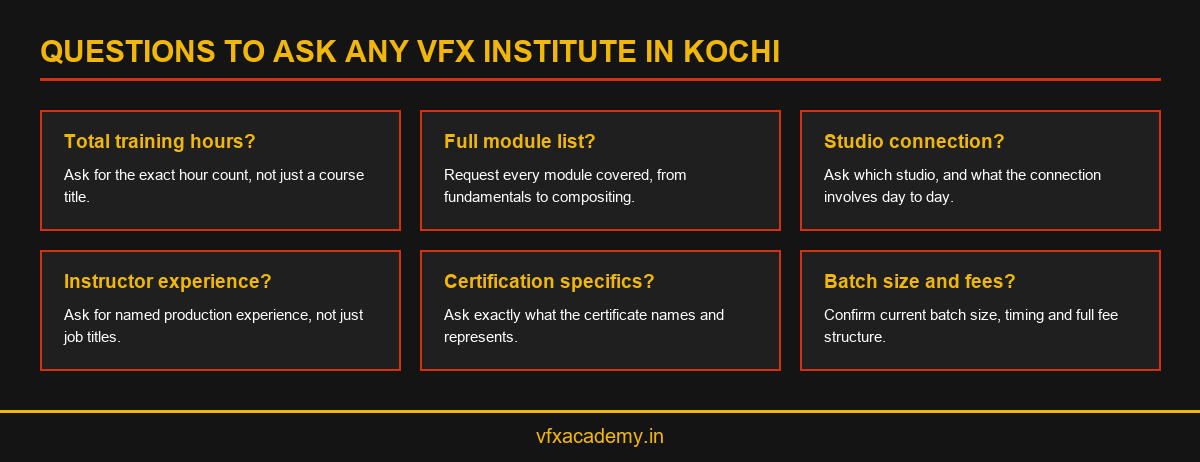
Ask for the full module list and total instructional hours, not just a course title. A genuinely deep VFX course covers rotoscopy, tracking, compositing and 3D integration as connected stages, typically across 400 or more hours. A course that compresses all of this into a fraction of that time is teaching software menus, not a pipeline.
Also ask which specific software is covered, Nuke, Mocha, Silhouette and Maya are common answers among serious VFX institutes, and whether the listed software is actually used throughout the course or only introduced once. Students who are still weighing whether they are ready for this level of detail may find our beginner’s roadmap to learning VFX from scratch useful before diving into institute comparisons.
It is worth asking one more layered question here: does the course teach each tool once, or does it return to the same tool in a harder context later. A single introduction to Nuke, for example, is very different training value from a course that uses Nuke repeatedly across increasingly complex compositing tasks through the later modules.
Questions to Ask About Studio Access and Instructor Background
Ask who is teaching each module and what production work they have personally done. An institute proud of its instructors will usually share this readily, including named projects or studio history where possible. Vague titles like senior faculty without any production specifics are worth following up on directly.
Ask, too, whether studio access means visiting a working space occasionally, or actually training inside it. These are very different claims, and the difference matters enormously for how much real production context a student absorbs during the course, separate from the module content itself.
It also helps to ask how feedback actually works. Some institutes offer group critiques where individual shot work rarely gets close attention, while others review each student’s roto, tracking and composite work directly. For detail heavy VFX skills, individual feedback tends to matter far more than group demonstrations, since mistakes in tracking or roto are often specific to one shot rather than a general concept everyone shares.
Class size is a related, practical question worth asking directly. A smaller batch generally makes individual shot feedback easier to deliver consistently, while a very large batch, even with strong instructors, can limit how much personal attention any one student’s work actually receives during a module.
Industry bodies such as the Visual Effects Society publish general standards and professional context for the wider VFX industry, which can be a useful reference point when you want to understand how production level work is typically structured, separate from any single institute’s own claims.
Questions to Ask About Certification, Fees and Batch Structure
If an institute advertises Hollywood or internationally associated certification, ask exactly what that certification names, which body issues it, and whether it applies to the full course or a specific module. This is a fair question at any institute, including Rays VFX Academy, and one worth asking directly during a free demo class rather than relying on brochure language.
On fees, ask for the complete cost breakdown in writing, including anything charged separately from the headline course fee, and whether flexible payment options exist. On batch structure, confirm current batch size, weekly hours and start dates directly, since these details shift between intakes and websites are not always updated in real time.
It is also reasonable to ask what happens if you need to pause or repeat a module, since VFX skills develop at different speeds for different students. A course rigid about pacing regardless of individual progress is a different commitment than one willing to adjust, and this is worth clarifying before, not after, you enrol.
Red Flags to Watch For When Comparing Kochi Institutes
Be cautious of any institute promising guaranteed job outcomes, since no legitimate VFX course can make that promise honestly. Also watch for vague answers about studio access, unnamed instructor credentials, and reluctance to share a detailed module breakdown when asked directly. For a fuller comparison framework, our piece on visual effects colleges vs studio-backed VFX academies covers this in more depth, including how traditional college programs differ from studio-backed academies.
If you are comparing institutes specifically by location and convenience within Kochi, our local buyer’s guide on VFX courses near me in Kochi is a useful next read alongside this checklist.
One final practical check: ask current or former students directly if possible, rather than relying only on testimonials selected by the institute itself. A short conversation with someone who actually completed the course, about pacing, feedback quality and studio access, often reveals more in five minutes than an hour spent reading marketing pages.
Conclusion
Choosing a VFX training institute in Kochi comes down to specific, verifiable answers, not brochure claims. Ask about curriculum hours, studio access, instructor background, certification specifics and fees before enrolling anywhere. See the full curriculum behind Rays VFX Academy’s approach in our VFX course in Kochi guide, or book a free demo class to ask these questions in person.
Frequently Asked Questions
What questions should I ask a VFX training institute before enrolling?
Ask about total training hours, the full module list, studio connections, instructor production experience, certification specifics and complete fee structure before enrolling anywhere.
How do I know if a VFX institute is really studio-backed?
Ask which studio it is connected to, what that connection involves day to day, and whether training happens inside the working space or only through occasional visits.
Are Hollywood-certified VFX courses in Kochi legitimate?
Certification claims vary widely. Always ask which body issues the certification and what it specifically covers before treating it as independently verified.
What is a reasonable duration for a serious VFX training institute course?
Most credible VFX courses run 5 to 6 months across 400 or more hours. Much shorter programs typically cover software basics rather than a full pipeline.
Should I visit a VFX institute in Kochi before enrolling?
Yes, strongly recommended. Most institutes, including this one, offer a free demo class specifically so prospective students can see the training environment first.
How important is instructor background when choosing a VFX institute?
Very important. Instructors with real production experience can answer workflow questions from practice, not theory, which meaningfully affects training quality at every stage.
What is a red flag when comparing VFX institutes in Kochi?
Be cautious of guaranteed job placement claims, vague studio access answers, and reluctance to share a detailed module breakdown or instructor credentials when asked.
Does Rays VFX Academy offer a walk-in demo class?
Yes, prospective students can visit for a free demo class. Details on current batch timing are available on our homepage and through direct enquiry.

You may also like
VFX Compositing Course: Learning Nuke, Mocha & Silhouette
VFX Editing Course: From Video Editing to Full VFX Production