3D Animation Course & Diploma: Curriculum, Career Path, and How to Choose
Choosing a 3D animation course is harder than it looks. Search results are full of institutes promising broad curriculums, yet few explain what you will actually build, which software you will master, or how a diploma differs from a short certificate. This guide breaks down the real curriculum behind a working 3D animation course, from modelling to the compositing handoff, and shows how Rays VFX Academy‘s studio-backed training inside the Rays3D pipeline changes what you walk away with once you finish.
Key Takeaways
- A genuine 3D animation course covers modelling, texturing, rigging, animation, rendering, and the handoff to compositing, not just software buttons.
- Diplomas, certificates, and short courses differ mainly in duration and depth, not in whether you learn Maya or Blender.
- Studio-backed training, like the pipeline behind Rays VFX Academy’s course, gives you exposure to how a real production actually moves work between artists across departments.
What a 3D Animation Course Covers vs a VFX Only Course
A 3D animation course and a VFX only course overlap, but they are not the same thing. Animation focuses on building and moving characters or objects inside three dimensional space, covering modelling, rigging, and motion. A VFX only course leans harder into compositing style work such as rotoscopy, matte painting, and integrating live footage with digital elements. Most students searching for a 3d animation course actually want both skill sets, because production studios rarely hire someone who can only model or only composite. Employers expect entry-level artists to at least understand how their piece of the pipeline connects to the next stage, even if their day-to-day role stays narrow.
This is exactly why Rays VFX Academy‘s course treats 3D animation as one stage inside a larger VFX pipeline rather than a standalone subject. Students build 3D assets in Maya, then hand that work into the compositing stage using Maya-Nuke integration and 3D Nuke, so the animation skills you learn are never separated from how they get used on an actual shot. If your goal is a portfolio that reflects real production thinking, look for a course structured this way rather than one that teaches animation and compositing as disconnected modules that never reference each other.
Think about a simple example, a monster reaching toward a camera in a horror sequence. The modeller builds the creature, the rigger gives it a moveable skeleton, the animator times its reach, and the compositor blends it into the live plate with correct shadows and colour grading. A course that teaches only one of those stages leaves you unable to speak the language of the other three, which matters when you eventually work on a real crew.
This overlap is also why the keyword phrases 3d animation course and vfx animation course are often searched by the same student at different points in their research. Early on, a student may search broadly for animation training. Later, once they understand how compositing fits in, the search shifts toward combined VFX and animation programs. A good institute should be able to serve a student at either stage of that journey without forcing an early, uninformed choice.
Curriculum Breakdown: Modelling, Rigging, Texturing, and the Compositing Handoff
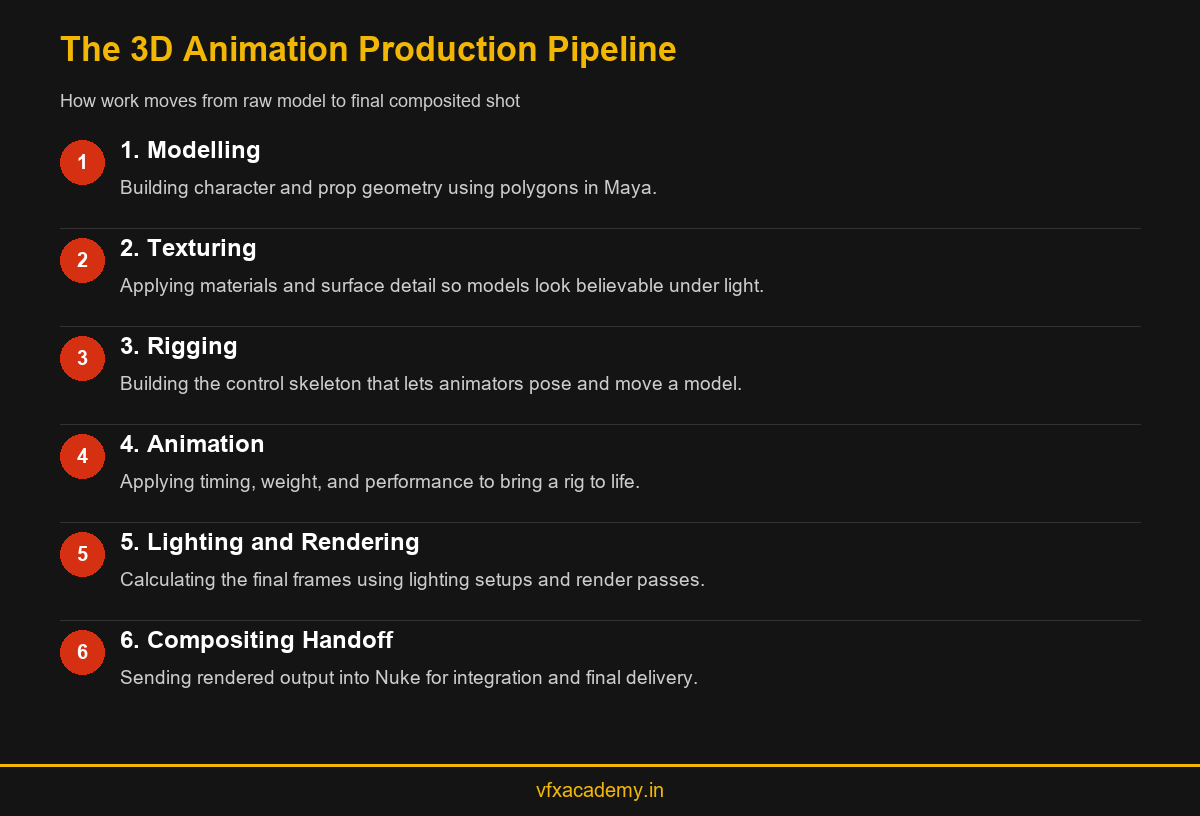
A production ready 3D animation curriculum moves through a clear sequence, and understanding this sequence helps you judge whether an institute’s syllabus is genuinely deep or just a list of software names strung together for a brochure. The stages below reflect how 3D computer graphics professionals actually organise their work in a studio, and how the diploma in 3D animation curriculum at Rays VFX Academy sequences its own training so that nothing is learned out of order.
Each stage produces something the next stage depends on. A model with clean geometry rigs more reliably. A well built rig animates more predictably. A cleanly rendered pass composites faster and looks more convincing. Institutes that skip explaining these dependencies often leave students able to operate software without understanding why professionals follow this exact order on every project.
Modelling and Texturing Fundamentals
Modelling is where a 3D animation course begins. Students learn to build objects and characters using polygons, then apply textures and materials so surfaces look believable under light. This stage teaches patience as much as software skill, since a poorly built model creates problems later in rigging and rendering that are far harder to fix downstream than they would have been to prevent early. Rays VFX Academy ties this stage to Maya from the start, so students are practising on the same tool used inside the Rays3D studio pipeline rather than a simplified classroom version built only for teaching purposes.
Rigging, Animation, and Rendering
Once a model exists, rigging adds the internal skeleton that lets an animator pose and move it. Animation principles such as timing, weight, and follow through get applied next, followed by lighting and rendering, where the scene is calculated into final frames ready for delivery or further processing. Students who reach this stage in a structured course can see, for the first time, how a static model becomes a moving shot with weight and intention behind every pose. Rendering output then flows into compositing, closing the loop back to the VFX side of the pipeline where the final image is assembled and graded.
Software Taught: Maya, Blender, and 3D Graphics Fundamentals
Software choice matters less than how deeply it is taught. Rays VFX Academy’s course centres on Autodesk Maya, the industry standard tool used for the modelling, rigging, and animation stages, and connects it directly into Nuke for compositing through Maya-Nuke integration and 3D Nuke workflows. This is a meaningful differentiator against generic multimedia institutes that teach software in isolation without showing how one tool’s output becomes another tool’s input further down the pipeline.
Understanding 3D graphics fundamentals, how polygons, normals, UV mapping, and render engines actually work underneath the interface, also matters more than memorising menu locations. Software interfaces change with every version update, but the underlying logic of how 3D graphics are constructed stays consistent, which is why a course grounded in fundamentals ages better than one built purely around a specific software version.
Photoshop and Illustrator also sit inside the wider curriculum, supporting texture creation and concept work that feeds into the 3D pipeline before a single polygon gets modelled. Students often underestimate how much of a finished 3D shot depends on flat, 2D image work happening earlier in the process, from reference sketches to texture maps painted directly onto a model’s surface.
Maya at Rays VFX Academy
Maya training at Rays VFX Academy is not a standalone module. It sits inside the 6-month, 400-hour course, connected to the same rotoscopy, chroma keying, and match moving skills students build elsewhere in the curriculum. Because instructors work inside the same Rays3D pipeline they teach, students see Maya used the way a working studio actually uses it, not a stripped down version built only to fit a syllabus. For a closer look at how Maya specific training is structured, see Maya Animation Classes.
Blender as an Accessible Companion Tool
Blender is a free, open source 3D graphics application available at blender.org that many self-taught students already use to practice modelling and animation before formal training begins. Because Blender applies similar pipeline logic to Maya, modelling, rigging, texturing, and rendering in a comparable sequence, the production thinking students build with one tool transfers to the other fairly easily. Our Blender VFX Course cluster covers this in more depth for students who want to start practising before enrolling.
Diploma vs Certificate vs Short Course: Duration and Depth Compared
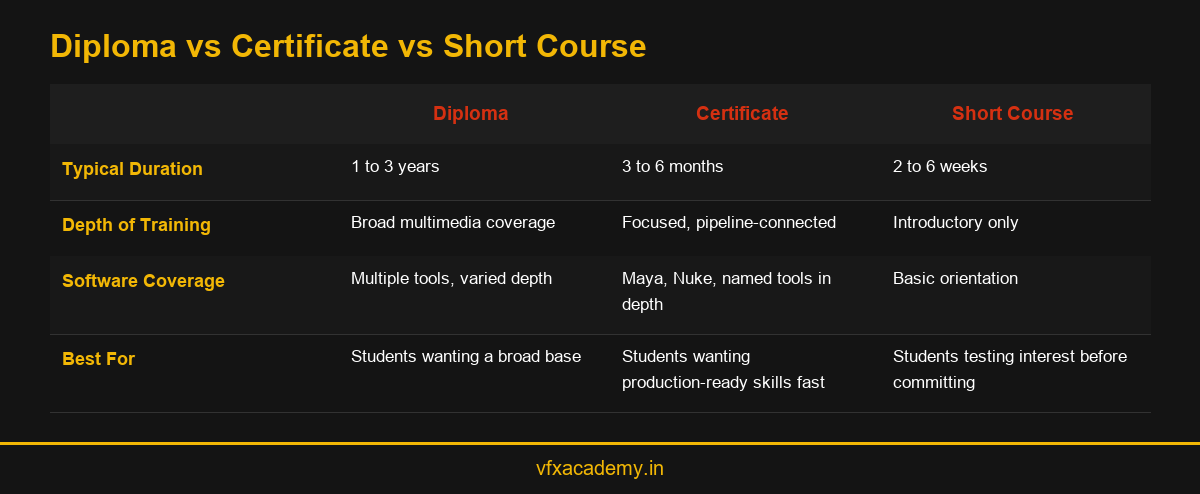
Across the Indian animation education market, students typically choose between three formats: a multi-year diploma, a certificate program lasting a few months, or a short course of a few weeks. Each option trades depth for time, and the right choice depends heavily on how much time and money a student and their family are prepared to commit before entering the workforce. A diploma usually spans one to three years and covers 3D animation as one part of a wider multimedia syllabus that may include subjects outside animation entirely. A certificate compresses training into months and focuses on specific software skills relevant to a single career direction. A short course, often a few weeks long, introduces basic concepts without production depth, and works best as an exploratory step rather than a career-ready credential.
Rays VFX Academy’s own course sits closer to the certificate model in duration, running 6 months across 400 hours, but goes deeper than a typical certificate because every module connects back to a working studio pipeline through Rays3D rather than existing as an isolated skill unit. Students comparing formats should weigh not just the number of months on a brochure, but how many of those hours are spent on guided, production-relevant practice versus general theory. Read Diploma in Animation: Programs, Duration, and Career Scope for a fuller breakdown of how diploma timelines compare across institutes in more detail.
Parents evaluating this decision for a child often ask which format offers the safest return on time invested. There is no universal answer, but a shorter, more focused course backed by real production exposure often prepares a student for entry-level work faster than a longer, broader diploma that spreads its hours across many unrelated subjects.
Who Should Take a Combined VFX Plus Animation Track
Not every student needs both skill sets equally, but most benefit from learning them together. Students fresh out of 12th grade who are still deciding on a specialisation gain the most from a combined track, since it lets them try modelling, rigging, and compositing before committing to one path permanently. Self-taught creators who already edit video or design graphics also benefit, because a combined course fills the structural gaps that scattered online tutorials leave behind, particularly around production pipeline discipline and consistent working habits under a deadline.
Career changers considering VFX after working in another field often ask whether they need animation training at all if they only want to composite. In practice, understanding how a 3D asset is built makes compositing decisions easier, since you know what the animator and modeller were trying to achieve with a given shot. For students weighing this exact decision, 3D Animation and VFX Courses Combined covers whether a dual-skill diploma is worth the extra time investment compared with a narrower, faster track.
There is also a practical hiring reason to consider a combined track. Smaller studios and freelance projects, which make up a large share of entry-level opportunities in India, often need artists who can flex between animation and compositing tasks depending on what a project needs that week. A narrow specialist has fewer opportunities early in their career than someone comfortable moving between adjacent tasks.
Parents sitting in on a free demo class often ask this same question from a different angle, wanting to know whether a combined track takes longer or costs more than a single-skill course. In Rays VFX Academy’s case, the combined approach is built into the same 6-month timeline rather than offered as a separate, extended track, since animation and compositing are treated as one connected subject from the first week of training.
Career Roles: 3D Modeller, Animator, and Character Artist
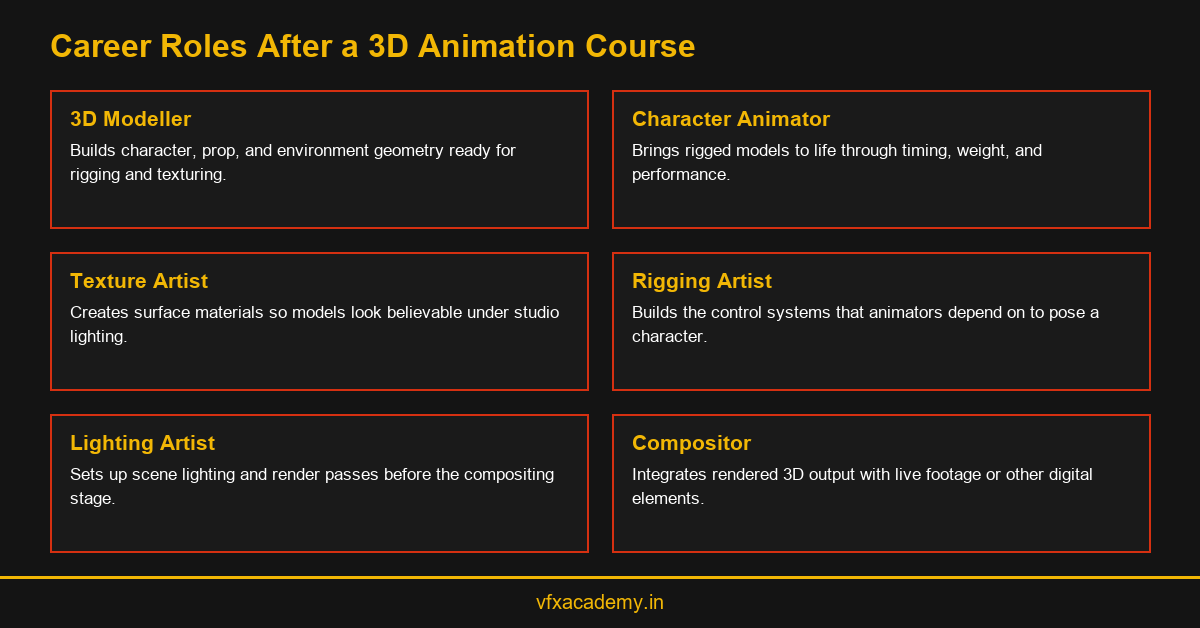
A completed 3D animation course opens several entry-level roles, and understanding what each one actually does helps you set realistic expectations before you enrol. A 3D modeller builds the geometry and surfaces for characters, props, and environments. A character animator brings those models to life through movement and performance. A texture artist focuses on how surfaces look under light, while a rigging artist builds the control systems animators depend on to pose a character convincingly.
These roles rarely work in isolation on a real production. Rays3D’s own history of 100+ VFX and 3D projects released over 12+ years of production work reflects how these roles interlock inside a working studio, rather than existing as separate specialisations taught in a vacuum with no connection between them. For a wider view of roles across the VFX industry generally, see Top 10 Career Opportunities in VFX.
Most artists specialise further as they gain experience rather than starting specialised on day one. A fresh graduate might rotate through modelling and texturing tasks for a year or two before a studio identifies where their strengths lie and moves them toward animation, lighting, or compositing full time. Treat your first job as a continuation of your training rather than the final destination, since the learning curve in this field rarely flattens quickly.
It also helps to build a habit of showing finished work, not just finished exercises. A short reel of three or four well executed shots, each showing a complete pipeline from modelling through to a rendered or composited frame, tends to say more to a hiring supervisor than a long reel padded with unfinished tests. Quality of completion matters more than quantity of clips when a recruiter is scanning dozens of student portfolios in a single sitting.
How Rays VFX Academy’s Studio Backing Changes the Learning Experience
Studio-backed training means students learn inside the working rhythm of an actual production environment rather than a simulated classroom exercise built only for teaching. This distinction matters more than most prospective students realise when comparing institutes, because it changes what instructors can actually show you beyond a fixed lesson plan.
Learning Inside a Working Studio Pipeline
Rays VFX Academy evolved directly from Rays3D, a production studio with over 12 years of experience and more than 5,000 artists trained. Students training here are exposed to the same pipeline logic used on real projects, not a scaled down textbook version written years ago and never updated. This is the core of the studio-backed positioning that separates Rays VFX Academy from classroom-only multimedia institutes competing for the same students.
Recognition That Signals Credibility
Rays3D was honoured by the Kerala Government in 2015 for its contribution to the self-employment sector, and has received a Lumiere Award for Technology recognition. The course also carries AIS/Hollywood-associated certification as a stated positioning point that the academy uses to differentiate itself in a crowded market. None of these facts replace your own due diligence, but they give parents and students a starting point for verifying an institute’s track record before enrolling and committing time or money.
What This Means for Your Portfolio
A portfolio built inside a studio-backed course tends to reflect production discipline that self-taught or classroom-only portfolios often lack, such as consistent file naming, sensible render settings, and shots that clearly show the handoff between stages. Recruiters reviewing student reels notice this difference quickly, since it signals a student already understands how a real pipeline expects work to be delivered, not just how to make an isolated shot look impressive on its own. A compositor evaluating incoming assets, for instance, can tell within minutes whether a model was built with clean topology and sensible naming, and that first impression shapes how much trust a junior artist earns on their first real assignment.
Choosing the Right 3D Animation Course: A Practical Checklist
With so many institutes covering similar keyword ground, from MAAC to Arena Animation to smaller regional academies, the differentiator is rarely the list of software names on the syllabus page. It is whether the course actually connects those tools to a working production process that mirrors how a real studio operates day to day.
Before enrolling anywhere, ask to see how modelling connects to rigging, how rigging connects to animation, and how animation output eventually reaches compositing. Ask whether instructors currently work in production or only teach, since active practitioners tend to keep their lessons current with how studios actually work today. Ask for the batch structure, the total hours, and whether there is a free demo class you can sit in on before committing any fees.
If you are researching institutes specifically in Kochi, 3D Animation Institute: What to Look for Before You Enroll in Kochi walks through this checklist in more local detail, covering campus visits and batch timing questions specific to that search. Our AI tools in 3D animation and VFX post also explains how emerging AI tools are reshaping parts of this workflow, which is worth understanding before you evaluate how future-focused a given curriculum really is.
Finally, be wary of any institute that leans on unverifiable claims instead of specifics. Vague promises about placement or salary outcomes are common across this market, but they tell you nothing about the actual training you will receive. A transparent institute will happily walk you through its curriculum hour by hour, introduce you to instructors, and let you see a student’s finished reel before you commit to a batch.
Conclusion
A strong 3D animation course teaches more than software. It teaches how modelling, rigging, texturing, and rendering connect into a single working pipeline, and how that pipeline hands off into compositing. Rays VFX Academy’s studio-backed course, built on the Rays3D production history, gives students that connected view rather than a list of disconnected lessons taught out of order. If you are ready to see how this training works in practice, book a free demo class and explore the full VFX course curriculum before you decide which institute is right for you.
Frequently Asked Questions
Is a 3D animation course the same as a VFX course?
No. A 3D animation course focuses on modelling, rigging, and movement, while a VFX course adds compositing, rotoscopy, and matte painting. Many institutes, including Rays VFX Academy, teach both together within one pipeline.
How long does a typical 3D animation course take?
Duration varies by format. Diplomas often run one to three years, certificates run a few months, and short courses run a few weeks. Rays VFX Academy’s course runs 6 months across 400 hours.
Which software is most important to learn first in 3D animation?
Maya is the most widely used industry tool for modelling, rigging, and animation. Blender is a strong free alternative for students who want to practice before or alongside formal training.
Can a beginner with zero experience join a 3D animation course?
Yes. Structured courses start with digital design fundamentals before moving into modelling and animation, so prior software experience is not required to begin.
What jobs can I get after a 3D animation course?
Common entry-level roles include 3D modeller, character animator, texture artist, and rigging artist. Many artists later specialise further as they gain production experience.
Is studio-backed training better than a classroom-only course?
Studio-backed training exposes students to real production pipelines and working professionals, which helps build practical judgment that classroom-only theory cannot fully replicate on its own.
Does Rays VFX Academy offer a standalone 3D animation diploma?
Rays VFX Academy’s flagship offering is its 6-month, 400-hour VFX course, which includes 3D animation training in Maya as part of an integrated production pipeline rather than as a separate diploma.
What is the difference between 2D and 3D animation training?
2D animation works in flat space using drawn or vector frames, while 3D animation builds and moves objects in three dimensional space. See 2D vs 3D Animation Courses for a detailed comparison.
How do I know if a 3D animation institute is credible?
Look for named production credits, verifiable years of studio experience, and transparent batch and fee details. Avoid institutes that rely only on vague quality claims without proof behind them.
Does 3D animation training help with a future VFX career?
Yes. Understanding how 3D assets are built makes later VFX work, particularly compositing and match moving, easier to approach with technical context. See Zero Upfront Fee VFX Courses for how fee planning works for combined tracks.

You may also like
Best 6-Month VFX and Animation Diploma, Explained