
3D Animation Institute: What to Look for Before You Enroll in Kochi
Kochi has become a genuine hub for creative training, which means students searching for a 3d animation institute now face more choices than ever, and more marketing noise along with it. Many institutes list similar software names and similar course titles, which makes real differences harder to spot at first glance. This guide covers exactly what to verify before enrolling anywhere in the city, from studio backing to named software depth, so you can compare institutes on substance rather than brochure claims.
Key Takeaways
- The most useful signal when comparing a 3D animation institute is whether training connects to a real, working production pipeline.
- Named software depth, specifically how deeply Maya and related tools are taught, matters more than a long list of software logos.
- A free demo class and transparent batch details are the easiest ways to verify an institute’s claims before committing.
Why Studio-Backed Training Matters When Comparing Institutes
Many institutes in Kochi advertise similar course titles, but the phrase studio-backed training means something specific and worth verifying directly. It means the institute is connected to an actual working production studio, not just a classroom that simulates production exercises. Rays VFX Academy evolved from Rays3D, a studio with over 12 years of production history and more than 100 VFX and 3D projects released, which shapes how its curriculum is taught day to day.
This distinction matters because instructors who currently work in production teach differently than instructors who only teach. They reference real deadlines, real client feedback loops, and real pipeline constraints that a purely academic curriculum rarely covers in enough depth to be useful once a student reaches an actual job.
Prospective students in Kochi often assume every institute offering a similar course title provides similar value, simply because the keywords on their websites overlap. In practice, the gap between a classroom-only program and a studio-backed one becomes visible the moment a student starts working, when they either recognise the pipeline logic from their training or have to relearn it from scratch on the job.
The AIS/Hollywood-associated certification that Rays VFX Academy references is another point worth raising directly during a campus visit or demo class, since it forms part of the academy’s stated positioning rather than something students should assume without asking for context on what it actually covers.
Checklist: What to Verify Before You Enroll
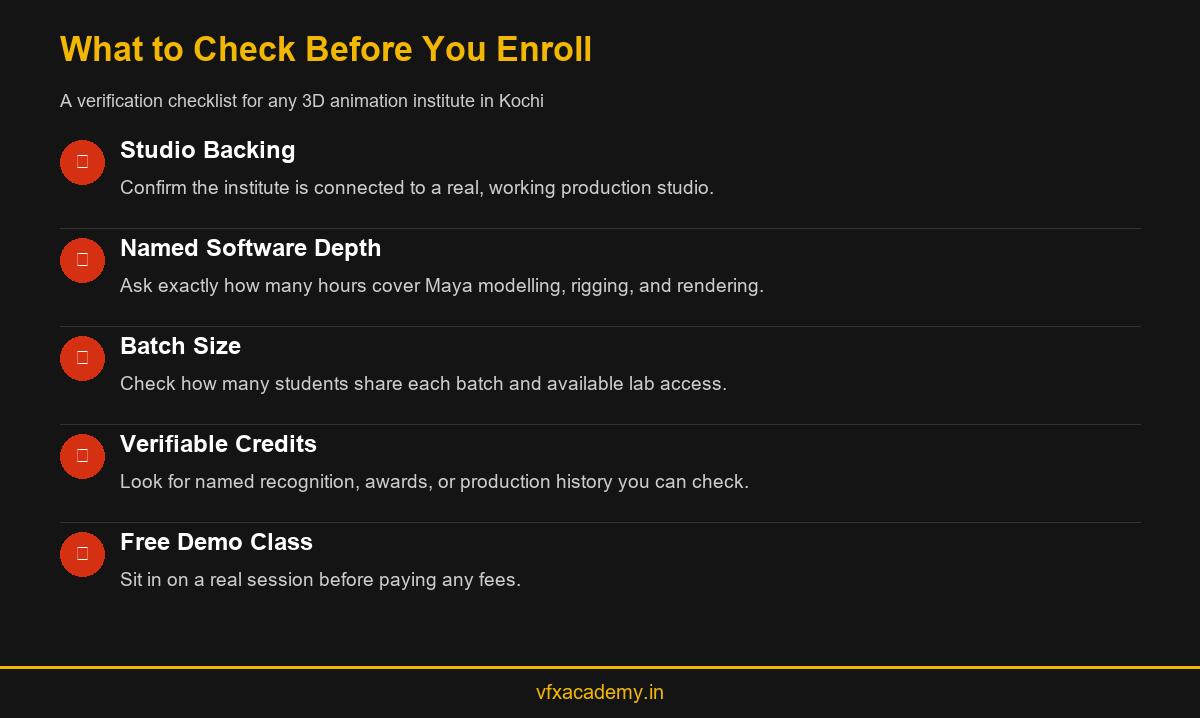
Before enrolling in any 3D animation institute, work through a short verification checklist rather than relying on a sales conversation alone. Confirm the total training hours, the exact software covered, and whether the institute can show finished student work rather than only promotional showreels. Ask whether a free demo class is available so you can sit in on real teaching before paying any fees.
Also ask how the institute handles students who fall behind during software-heavy weeks, since modelling and rigging build on each other and a student who misses a fundamental step often struggles later without catching up. A transparent institute will explain its support structure clearly, whether that means extra lab hours, recorded sessions, or one on one instructor time, rather than leaving struggling students to work it out alone.
Finally, ask for a plain answer on fees, including whether any additional costs apply beyond the headline course price. Institutes that are upfront about total cost from the first conversation are generally easier to trust than those that only reveal add-on charges after a student has already committed.
Software Depth and Named Production Credits to Look For
A long list of software names on a syllabus page tells you less than how deeply any single tool is taught. Ask specifically how many hours are dedicated to 3D computer graphics fundamentals like modelling and rigging, versus general orientation sessions that barely scratch the surface of a tool’s real capability.
Named production credits are another useful signal. Rays3D’s history includes recognition such as a Kerala Government honour in 2015 for contribution to the self-employment sector and a Lumiere Award for Technology. Institutes willing to name specific, verifiable achievements tend to be more transparent overall than those relying only on broad, unverifiable claims about quality or outcomes.
It is also reasonable to ask how a course connects modelling and rigging skills to the compositing stage that follows. An institute that stops teaching once a shot is rendered leaves students without a full picture of how their work is actually used once it leaves their hands, which is a common gap between narrow software training and genuine production education. Rays VFX Academy addresses this directly by teaching Maya-Nuke integration and 3D Nuke as part of the same course, so the handoff between animation and compositing is never treated as someone else’s problem.
Batch Structure, Campus Access, and the Free Demo Class
Batch size directly affects how much individual attention a student receives, particularly during software-heavy sessions where getting stuck without help wastes valuable class time. Ask how many students are typically in a batch, and whether campus access includes hands-on lab time outside scheduled sessions.
A free demo class remains the single most reliable way to judge fit before committing. Sitting in on an actual session shows you the pace of teaching, the quality of the workspace, and whether instructors answer questions clearly under real classroom conditions rather than a polished sales pitch. If a Kochi institute is unwilling to offer this, treat that reluctance as a signal worth investigating further.
Campus access outside scheduled hours also matters more than most students expect going in. Modelling and rendering work often benefits from extra, unhurried practice time, and an institute that restricts lab access strictly to class hours can slow down a student’s progress compared with one that allows supervised extra time on workstations.
How Rays VFX Academy Fits Kochi’s Local Market
Kochi and the wider Ernakulam region have a growing creative economy, and local students increasingly want training that does not require relocating to Mumbai, Bangalore, or Chennai to access studio-quality instruction. Rays VFX Academy’s Kochi campus positions its studio-backed course as a local alternative to relocating for training, while still connecting students to Maya and Nuke depth comparable to larger national institutes.
For students comparing multiple options across the city and wider Kerala, our 3D Animation Course and Diploma guide covers curriculum depth in more detail, and 3D Animation Design: Skills, Software, and Tools breaks down exactly which software skills to prioritise when comparing institutes side by side.
For families weighing the cost of relocating a child to another city for training, a local studio-backed option can meaningfully change the overall decision, not just on cost but on convenience of ongoing support after the course ends. Students who train close to home also find it easier to stay connected to their institute’s network as they start applying for their first industry opportunities.
National chains bring broad brand recognition, but their centre-by-centre experience can vary since franchise structures do not always guarantee identical teaching quality across every location. A locally rooted, studio-backed institute in Kochi can offer a more consistent experience precisely because there is one campus, one team, and one pipeline behind the training rather than a network of separately run centres. This does not mean every local institute is automatically better than every national chain, only that the same checklist, studio access, named software depth, batch size, and verifiable credits, should apply either way rather than assuming a bigger brand name guarantees better training for a specific student’s goals.
Conclusion
Choosing a 3D animation institute in Kochi comes down to verification, not marketing claims. Check studio backing, software depth, batch structure, and named credits before you commit any fees. Book a free demo class at Rays VFX Academy to see the training in person before deciding which institute earns your enrollment.
Frequently Asked Questions
What should I check before joining a 3D animation institute in Kochi?
Verify total training hours, exact software coverage, batch size, and whether a free demo class is available before you pay any fees or commit to a program.
Is studio-backed training available in Kochi?
Yes. Rays VFX Academy in Kochi offers studio-backed training connected to Rays3D, a production studio with over 12 years of experience and 100+ released projects.
How big are typical batch sizes at animation institutes?
Batch sizes vary by institute. Smaller batches generally allow more individual attention during software-heavy sessions, so it is worth asking directly before enrolling.
Do I need to relocate outside Kerala for quality 3D animation training?
Not necessarily. Studio-backed institutes based in Kochi, such as Rays VFX Academy, offer training comparable in software depth to larger institutes in other Indian cities.
What is the difference between a classroom-only institute and a studio-backed one?
A studio-backed institute is connected to an active production studio, so instructors reference real pipeline experience rather than teaching from a purely academic syllabus.
Can I visit a 3D animation institute before enrolling?
Most transparent institutes, including Rays VFX Academy, offer a free demo class so prospective students can evaluate teaching quality before committing.
Are Maya and Blender both taught at Kochi institutes?
Coverage varies by institute. Rays VFX Academy centres its training on Maya integrated with Nuke; see Maya Animation Classes for details on how this training is structured.
How do I compare 3D animation institutes near me in Kochi?
Compare curriculum hours, software depth, and verifiable production history rather than relying on marketing claims alone. See 3D Animation Courses Near Me for a wider comparison approach.

You may also like
Diploma in 3D Animation: Full Curriculum Breakdown
3D Animation Design: Skills, Software, and Tools You’ll Master