Best 6-Month VFX and Animation Diploma, Explained
Six months is a specific, deliberate length for a VFX and animation diploma, not an arbitrary number. This guide explains why Rays VFX Academy’s course is paced across 6 months and 400 hours, what that timeline actually includes, and why compressing it further would trade away skill depth.
- A 6-month, 400-hour format allows spaced practice across rotoscopy, tracking, and compositing, which supports stronger skill retention than a compressed course.
- The pacing is built around six sequential modules, each depending on skills built in the previous one.
- Shorter, compressed courses can work for a single specific skill, but rarely replicate full pipeline depth in less time.
Why 6 Months Is the Deliberate Length, Not a Default
A VFX and animation diploma covering the full pipeline, design fundamentals, editing, rotoscopy, tracking, and compositing, needs enough time for each skill to be practised, critiqued, and revised before the next one builds on top of it. Rays VFX Academy’s 6-month, 400-hour structure reflects that requirement rather than an arbitrary marketing number.
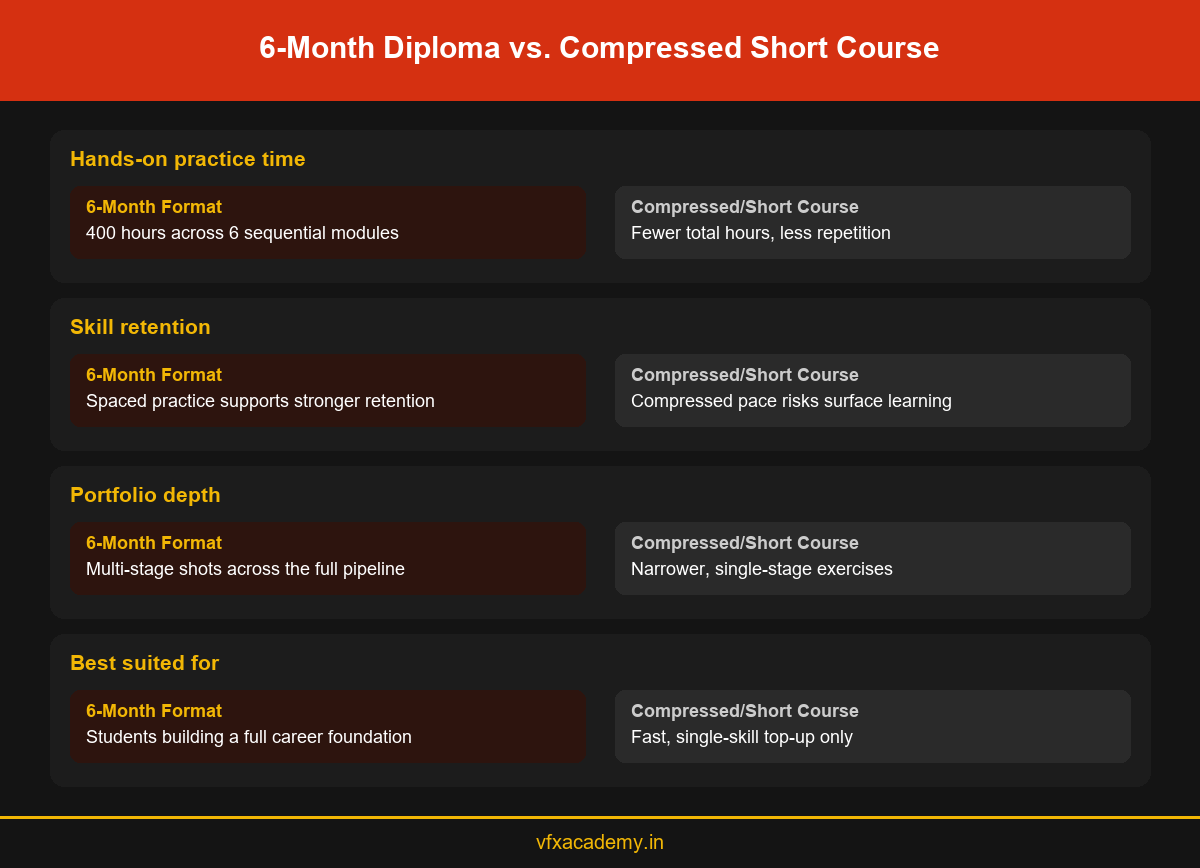
Compressing the same content into 6 or 8 weeks is possible in theory, but it usually means cutting either total hands-on hours or the number of revision cycles a student gets on each assignment. Both directly affect how production-ready a student’s portfolio looks by the end of the course.
What the 400 Hours Actually Cover
The course divides its 400 hours across six modules: digital design foundations with Photoshop and Illustrator, video editing and motion graphics, rotoscopy and chroma keying, matte painting with clean plate and wire removal, match moving and camera tracking, and finally Maya–Nuke compositing with the stereoscopic pipeline.
Each module includes both instruction and hands-on studio practice, reviewed against Rays3D production standards. This is the part that a compressed course structurally struggles to replicate: fewer total hours means less time for instructors to review and send work back for revision, which is often where the real learning happens.
For the complete module-by-module breakdown, see Diploma in Animation and Multimedia: Full Course Guide.
When a Shorter Course Actually Makes Sense
A compressed, shorter course can be the right choice for a narrow goal: a working professional adding one missing tool skill, such as tracking in Mocha, to existing broader VFX experience. For a first-time student building a full career foundation, that same compression usually leaves real gaps in the pipeline stages that get cut for time.
The honest test is to ask what a shorter course actually removes to fit its timeline: fewer modules, fewer practice hours per module, or less individual feedback. Any institute offering a compressed VFX and animation diploma should be able to answer that specifically rather than just advertising a faster finish date.
How to Evaluate Pacing Before You Enrol
Ask for the total instructional hours, not just the number of weeks, since class frequency varies. Ask how many revision cycles a typical assignment gets before moving to the next module. And ask whether the course timeline has changed over time, since institutes sometimes compress a program’s duration without reducing its marketed scope.
Rays VFX Academy’s 6-month pacing has stayed consistent because it is built around what the modules genuinely require, not around a competitive urge to advertise the shortest course on the market. A free demo class is the most direct way to see how a single week of that pacing actually feels before committing to the full 6 months.
Conclusion
Six months is not a default length for a VFX and animation diploma; it is the time the full pipeline, design through compositing, genuinely needs for hands-on practice and revision. Rays VFX Academy’s 400-hour format is paced around that requirement rather than compressed for a faster marketing claim. Book a free demo class to see the pacing in person before deciding.
People Also Ask
Why does a VFX and animation diploma take 6 months?
The 400-hour format needs to cover six sequential modules with enough hands-on practice and revision time for each skill to build properly on the last.
Can a VFX and animation diploma be completed faster?
Some institutes offer compressed formats, but this usually trades away total practice hours or revision cycles, which can leave gaps in a student’s final portfolio.
Is a shorter VFX course ever the right choice?
Yes, for a working professional adding one specific missing skill to existing broader VFX experience. For a first-time student, a full 6-month format generally covers more ground.
What is covered across the 400 hours of Rays VFX Academy’s diploma?
Digital design foundations, video editing, rotoscopy, chroma keying, matte painting, match moving, camera tracking, and Maya-Nuke compositing with the stereoscopic pipeline.
How can I compare pacing between different VFX diploma options?
Ask for total instructional hours, number of revision cycles per assignment, and whether the course length has changed over time without reducing its marketed scope.

You may also like

Diploma in Animation After 10th: Eligibility and Career Path