
VFX Artist Course: Skills, Software & Career Roles
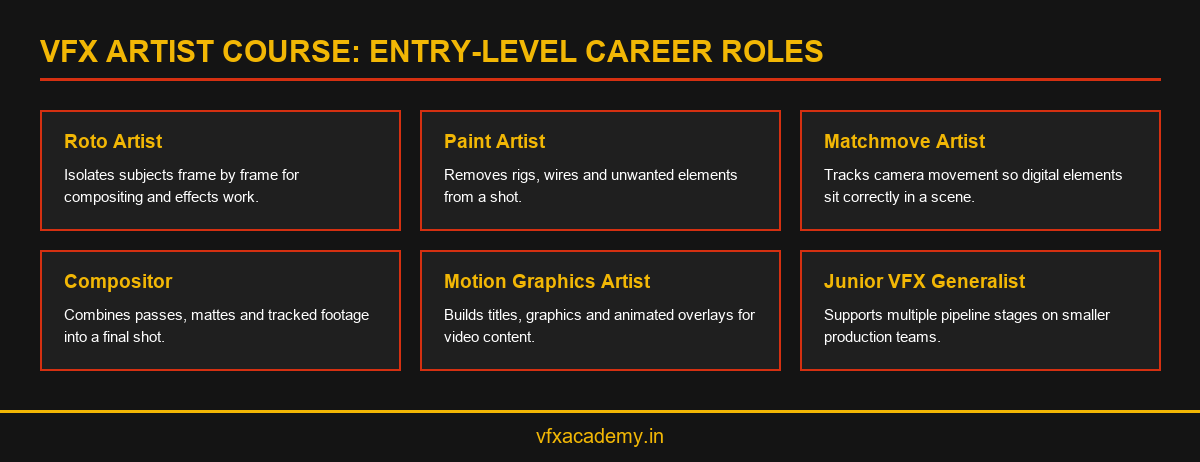
"VFX artist" is not one job. It is a cluster of specialised roles, roto artist, paint artist, matchmove artist, compositor, each built on a different slice of the same pipeline. A VFX artist course should tell you plainly which of those roles it actually prepares you for, not just list software names. This guide breaks down the skills, tools and entry-level roles behind Rays VFX Academy’s 6-month, 400-hour course.
Key Takeaways
- A VFX artist course should map directly to specific entry-level roles, not just teach software in isolation.
- Rays VFX Academy’s course covers roto, paint, matchmove and compositing across its six production modules.
- Which role fits you best depends on whether you prefer precise, repetitive detail work or creative shot assembly.
What a VFX Artist Course Should Actually Cover
A course that only teaches Nuke or After Effects buttons is not the same as one that teaches you to think like a VFX artist. The difference shows up in how a course sequences its training: fundamentals first, then rotoscopy and tracking, then compositing, each stage building toward a specific, hireable skill rather than a general familiarity with software menus.
Rays VFX Academy structures its 6-month, 400-hour course around this sequencing, moving from digital design foundations through rotoscopy, chroma keying and matte painting, into match moving and camera tracking, and finally into Maya-Nuke compositing and the stereoscopic pipeline. Each stage corresponds to a real production role, which is what separates a VFX artist course from a general multimedia course.
Core Skills Every VFX Artist Course Should Teach
Rotoscopy is usually the first specialised skill students encounter, isolating a subject frame by frame so it can be separated from its background. It is precise, repetitive work, and how a course teaches it, on real messy footage versus clean stock clips, says a lot about whether the training reflects actual production conditions.
Match moving, or camera tracking, is the next core skill: reconstructing a camera’s movement in 3D space so digital elements sit convincingly inside a live-action shot. This is where match moving work overlaps with tools like Mocha and Silhouette, covered in more depth in our guide to VFX compositing course tools.
Compositing brings everything together: multiple render passes, tracked footage, roto mattes and paint work combined into one believable final shot. It is the skill most entry-level VFX artist roles eventually lead toward, and the reason Rays VFX Academy’s course spends its final modules on Maya-Nuke integration, multi-pass compositing and stereoscopic work.
Software a VFX Artist Course Should Include
Photoshop and Illustrator build the design fundamentals most VFX artist roles assume you already have. From there, Maya handles 3D elements and camera work, while Nuke, Mocha and Silhouette cover tracking, rotoscopy and compositing specifically. A course missing any one of these tends to leave a visible gap in a student’s eventual portfolio.
It’s worth asking any institute exactly which of these tools you get hands-on time with, not just which ones are mentioned on a syllabus page. Rays VFX Academy’s course builds toward Maya-Nuke integration directly, so students leave with working familiarity across the full toolset rather than surface exposure to one or two programs.
Which Role Should You Aim For First
Students who enjoy precise, methodical work often gravitate toward roto and paint roles early on, since these positions reward patience and attention to detail more than creative decision-making. Students who prefer assembling a full shot from multiple elements tend to move toward compositing faster, especially once they’ve built confidence with tracking and matte work.
Neither path is a fixed decision. Most VFX artists rotate through roto, paint and tracking work before specialising in compositing, since understanding each upstream stage makes you a better compositor later. A VFX artist course that exposes you to all of these stages, rather than skipping straight to the most "exciting" one, sets you up better for that eventual specialisation.
Conclusion
A VFX artist course is only useful if it maps clearly to real entry-level roles: roto, paint, matchmove and compositing. Rays VFX Academy’s 6-month, 400-hour course is built around that exact progression. Explore the full curriculum in our VFX course in Kochi guide, or book a free demo class to see the studio pipeline for yourself.
Frequently Asked Questions
What roles can I get after a VFX artist course?
Common entry-level roles include roto artist, paint artist, matchmove artist, compositor and motion graphics artist, depending on which stage of the pipeline you specialise in.
Do I need to know all VFX software before enrolling?
No. A structured VFX artist course, including Rays VFX Academy’s 6-month program, teaches Photoshop, Illustrator, Maya, Nuke, Mocha and Silhouette from the fundamentals up.
Is rotoscopy still a useful skill to learn?
Yes. Rotoscopy remains a core production task across film, advertising and content pipelines, and it is often the first specialised skill a junior VFX artist builds real confidence in.
What is the difference between a compositor and a general VFX artist?
A compositor specifically combines tracked footage, mattes and render passes into a final shot. "VFX artist" is a broader term covering any specialised role across the pipeline, compositing included.
How long does it take to become job-ready as a VFX artist?
Rays VFX Academy’s course runs 6 months across 400 hours. Job readiness also depends on the strength of the portfolio built during and after the course, not the duration alone.
Can a self-taught creative skip a VFX artist course?
It’s possible to learn some tools independently, but structured career-focused training with studio feedback typically closes pipeline gaps faster than self-taught tutorials alone.

You may also like
VFX Compositing Course: Learning Nuke, Mocha & Silhouette
VFX Editing Course: From Video Editing to Full VFX Production