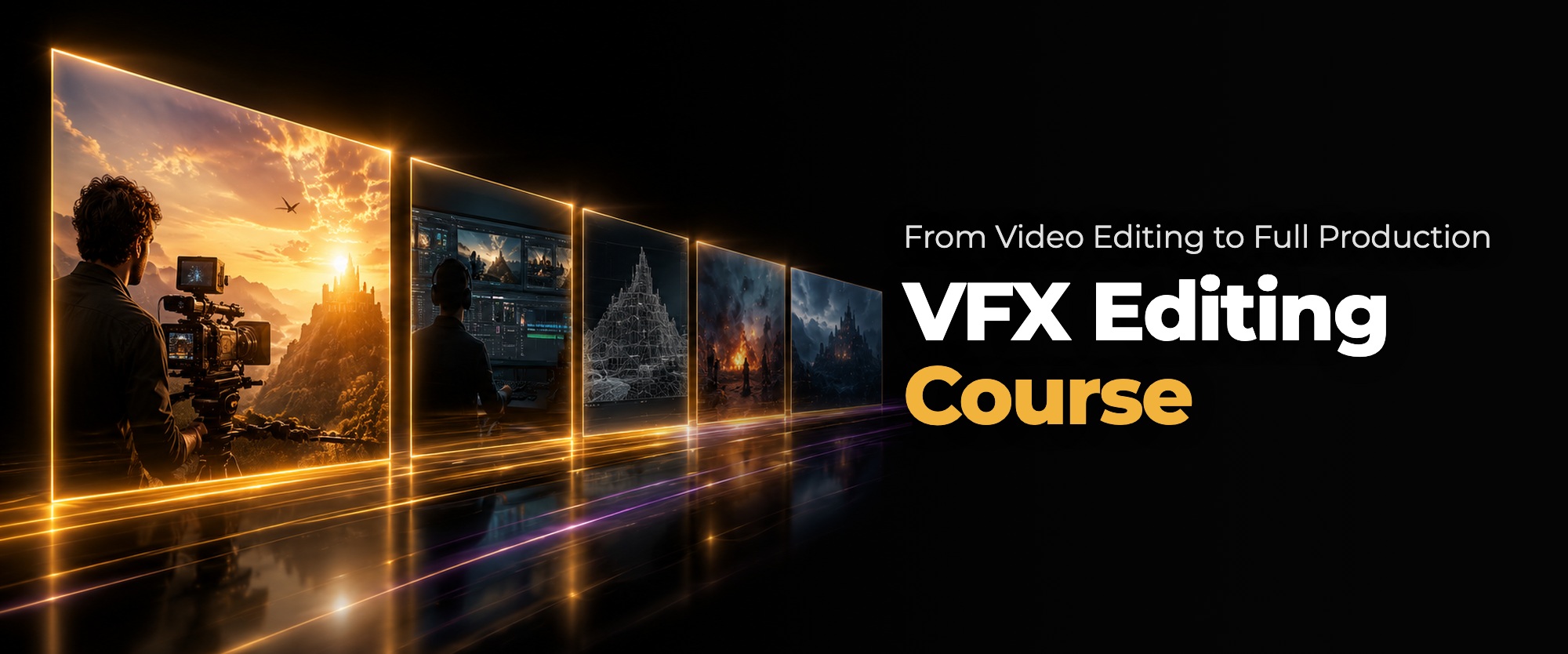
VFX Editing Course: From Video Editing to Full VFX Production
A lot of students search for a "VFX editing course" while actually meaning two different things: learning to edit video that includes VFX shots, or learning to build visual effects itself. This guide clarifies that distinction and walks through how Rays VFX Academy’s 6-month, 400-hour course takes a student from video editing fundamentals into full VFX production.
Key Takeaways
- "VFX editing" often gets confused with video editing; they are related but distinct skill sets.
- A proper VFX editing course starts with editing and motion graphics before moving into rotoscopy, tracking and compositing.
- Rays VFX Academy’s course is sequenced so editing fundamentals support, rather than replace, full VFX training.
Video Editing vs. VFX: Where the Confusion Comes From
Video editing focuses on assembling footage, cuts, pacing, audio sync, and basic colour correction, using tools like Premiere Pro. VFX focuses on modifying or adding to individual shots, tracking, rotoscopy, compositing, using tools like Nuke, Mocha and Maya. Both matter, but they are different disciplines with different learning curves.
The confusion is understandable. Many self-taught creatives start as video editors and grow into VFX work over time. That path is realistic, but it works best when the transition is planned as structured training, rather than picked up in fragments from scattered tutorials.
How Rays VFX Academy Sequences Editing Into Full VFX Training
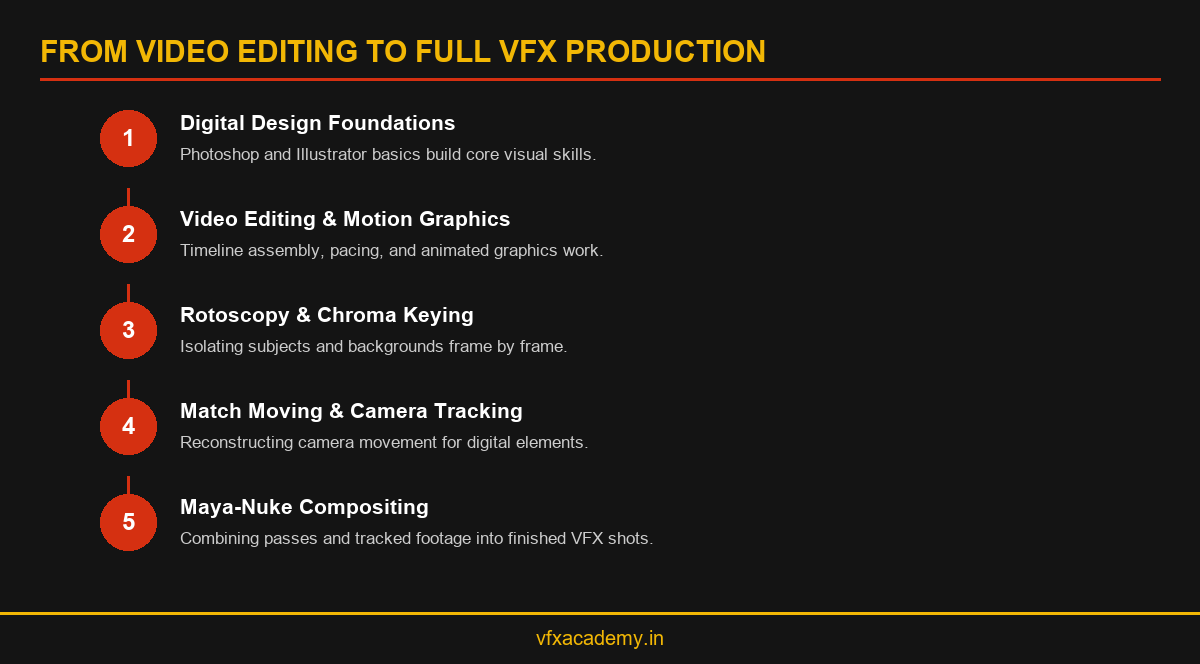
The course opens with digital design foundations, Photoshop and Illustrator, followed by video editing and motion graphics. This isn’t filler content before the "real" VFX modules start. It builds the visual and timing instincts that make rotoscopy, compositing and matte painting easier to learn once they’re introduced.
From there, the course moves into rotoscopy, chroma keying and matte painting, then match moving and camera tracking, and finally Maya-Nuke compositing. Students who already understand pacing and shot assembly from the editing stage tend to grasp compositing decisions faster, since composting is, in a sense, editing at the level of individual pixels and passes. For a closer look at where this leads career-wise, see our guide on VFX artist course roles and skills.
Should You Start With Editing or Jump Straight to VFX Tools
If you already edit video comfortably, you can move through the editing and motion graphics module of a VFX editing course quickly and spend more of your time on rotoscopy, tracking and compositing. If you’re starting from zero, the editing foundation is not optional; it’s what makes the harder VFX-specific modules learnable in the first place.
Either way, the goal of a genuine VFX editing course should be full VFX production capability, not just faster cuts. A course that stops at editing and motion graphics without progressing into tracking and compositing is a video editing course wearing a VFX label.
What This Looks Like in Practice at Rays VFX Academy
Students work inside the Rays3D production environment rather than a standalone classroom, which means editing and motion graphics assignments are reviewed with the same production standards used for compositing work later in the course. That continuity matters: it teaches students that editing decisions, timing, framing, pacing, directly affect how believable a VFX shot feels once effects are added.
By the time students reach the compositing and stereoscopic pipeline modules, the editing fundamentals from earlier in the course are no longer a separate skill; they’re part of how the student evaluates their own compositing work for pacing and visual flow.
Conclusion
A genuine VFX editing course should take you from editing fundamentals all the way into full VFX production, not stop halfway. Rays VFX Academy’s 6-month, 400-hour course is structured to do exactly that. See the complete breakdown in our VFX course in Kochi guide, or book a free demo class to see the editing-to-compositing pipeline in action.
Frequently Asked Questions
Is a VFX editing course the same as a video editing course?
No. Video editing focuses on assembling footage. A genuine VFX editing course should build on editing fundamentals and progress into rotoscopy, tracking and compositing.
Do I need video editing experience before starting a VFX course?
No, but it helps. Rays VFX Academy’s course includes a video editing and motion graphics module early on, so beginners build that foundation as part of the course.
What software is used in a VFX editing course?
Typically Premiere Pro or similar tools for editing, alongside Photoshop, Illustrator, Maya, Nuke, Mocha and Silhouette for the VFX-specific stages.
How long does it take to go from editing to full VFX skills?
Rays VFX Academy’s structured path covers this across 6 months and 400 hours, moving from editing foundations through to Maya-Nuke compositing.
Can a video editor transition into VFX work later?
Yes, this is a common and realistic path, though it works best through structured training rather than fragmented, self-taught tutorials.

You may also like
Diploma in 3D Animation: Full Curriculum Breakdown
3D Animation Design: Skills, Software, and Tools You’ll Master