
Diploma in Animation After 10th: Eligibility and Career Path
Not every student waits until after 12th to start building creative skills. A diploma in animation after 10th is a real option for students who already know they want to move toward animation or VFX early. This guide covers eligibility, how the course adjusts for younger entry points, and the career path it leads toward.
- 10th pass students are eligible to enrol in Rays VFX Academy’s diploma course; no prior animation experience is required.
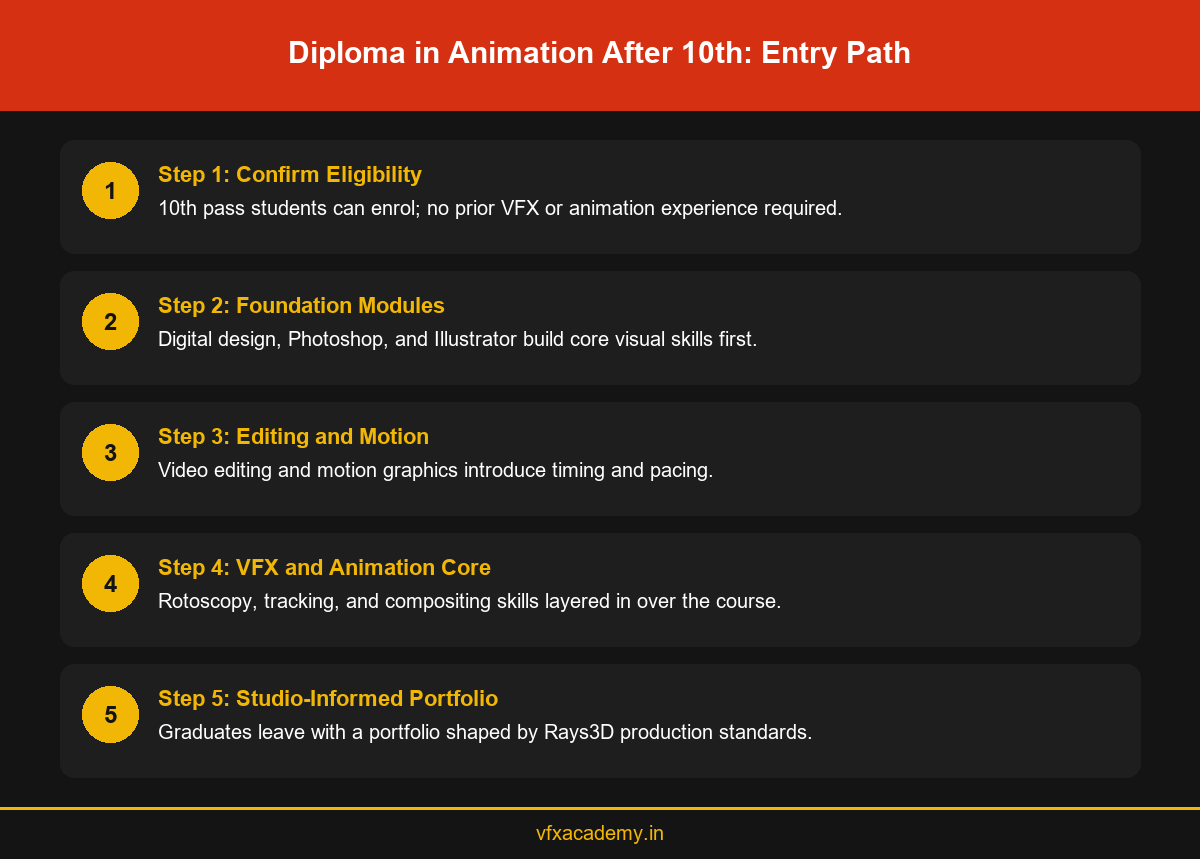
- The course sequence stays the same regardless of entry point, starting with design foundations before moving into VFX-specific skills.
- Younger students benefit from extra guidance on pacing and study habits alongside the standard curriculum.
Eligibility for a Diploma in Animation After 10th
Rays VFX Academy accepts students directly after 10th grade into its 6-month, 400-hour diploma course. There is no requirement for prior design, animation, or software experience. The course is structured to teach digital design fundamentals, Photoshop and Illustrator, from the very first module, which means a 10th pass student starts on equal footing with a 12th pass or career-change student.
What matters more than academic background is genuine interest and willingness to commit to structured, hands-on training. Since the course runs in fixed batches with group critique and instructor feedback, consistent attendance matters more for a younger student’s progress than any specific prior qualification.
For students still deciding between entry points, it can help to compare this path against options for older students. See Diploma in Animation and Multimedia: Full Course Guide for the broader curriculum most students, regardless of entry point, move through.
How the Course Adjusts for Younger Students
While the curriculum sequence stays consistent, instructors at Rays VFX Academy pay closer attention to pacing for students who have just finished 10th grade. Foundational modules, design fundamentals and basic editing, get slightly more guided practice time before the course moves into VFX-specific modules like rotoscopy and camera tracking.
This is not a diluted version of the curriculum. It is the same 400-hour, six-module structure taught inside the Rays3D production environment, with instructors adjusting explanation depth rather than skipping content. By the time the course reaches Nuke compositing in the final modules, younger students are working at the same level as their batch-mates.
Career Path After a Diploma in Animation Taken After 10th
Graduates who complete this diploma at a younger age often have a longer runway to build experience before their peers finish traditional 12th-plus-college pathways. Entry-level roles such as junior roto artist, motion graphics assistant, or junior 3D artist remain the realistic starting point, the same as for any graduate of the course.
Some younger graduates choose to pursue further academic education alongside or after this diploma, using it as an early skills foundation rather than a final career step. Others move directly into entry-level studio work. See our guide on VFX career opportunities for a broader view of common roles this training leads toward.
Parents evaluating this path for a younger student should weigh it as a head start rather than a replacement for continued learning. The skills built, design, editing, rotoscopy, tracking, and compositing, remain valuable regardless of whether a student later combines them with further formal education.
What to Ask Before Enrolling a 10th Pass Student
Ask how the academy supports younger students specifically: is there additional mentorship, how are batches mixed by age or entry point, and how is progress communicated to parents throughout the 6 months. A studio-connected academy should be able to answer these questions concretely rather than vaguely.
It also helps to attend a free demo class together with the student before enrolling, so both the student and parent can see the training environment and ask questions about pacing directly, rather than relying on a course description alone.
Conclusion
A diploma in animation after 10th is a genuine, structured option for students who want an early start in animation and VFX, not a shortcut with reduced content. Rays VFX Academy’s 6-month course keeps the full curriculum intact while adjusting pacing support for younger students. Book a free demo class to see how the course structure fits a 10th pass entry point.
People Also Ask
Can I join a diploma in animation right after 10th grade?
Yes. Rays VFX Academy accepts 10th pass students into its 6-month, 400-hour diploma course with no prior animation or design experience required.
Is the curriculum different for 10th pass students compared to 12th pass students?
The module sequence is the same for all students. Instructors may adjust pacing and guided practice time for younger students in the early foundation modules.
What career roles can a 10th pass graduate apply for?
Entry-level roles such as junior roto artist, motion graphics assistant, or junior 3D artist are realistic starting points, the same as for any graduate of the course.
Should a 10th pass student continue academic education alongside this diploma?
Many students do combine the two. This diploma works well as an early skills foundation regardless of whether further formal education follows.
How long is the diploma in animation course for a 10th pass student?
The course runs 6 months across 400 hours, the same duration and structure regardless of entry point.
Can parents attend the demo class with a younger student?
Yes, and it is recommended. Attending together lets both the student and parent see the training environment and ask pacing-related questions directly.

You may also like

Best 6-Month VFX and Animation Diploma, Explained