
3D Animation and VFX Courses Combined: Is a Dual-Skill Diploma Worth It
Combining 3D animation and VFX courses into a single diploma sounds efficient on paper, but it raises a fair question: does covering both tracks dilute either one? This guide breaks down what a dual-skill diploma actually includes at Rays VFX Academy, how it compares to choosing one specialisation, and who genuinely benefits from the combined format.
- A dual-skill diploma covers both animation fundamentals and VFX-specific compositing, not two separate half-courses squeezed together.
- Combined training suits students who are not yet certain whether they want to specialise in animation or VFX post-production.
- Students who already know they want deep VFX-only or animation-only skills may be better served by a single-track course instead.
What a Combined 3D Animation and VFX Course Actually Covers
A genuine dual-skill diploma does not simply bolt two unrelated syllabi together. At Rays VFX Academy, the 6-month, 400-hour course sequences digital design foundations and video editing first, then moves into VFX-specific modules: rotoscopy, chroma keying, matte painting, match moving, camera tracking, and finally Nuke compositing with Maya integration.
The combined format works because animation and VFX post-production share a surprising amount of foundational skill: understanding movement, timing, and how a 3D element needs to sit believably inside a shot. Students who learn both together often develop a more complete understanding of how a finished VFX shot is actually built, from asset to final composite.
This differs meaningfully from the broader 3D Animation Course and Diploma pillar guide, which focuses more heavily on modelling, rigging, and animation-specific software depth. A combined course keeps animation fundamentals but weights more of its later modules toward VFX compositing and post-production skill.
The Real Trade-Off: Breadth vs. Depth
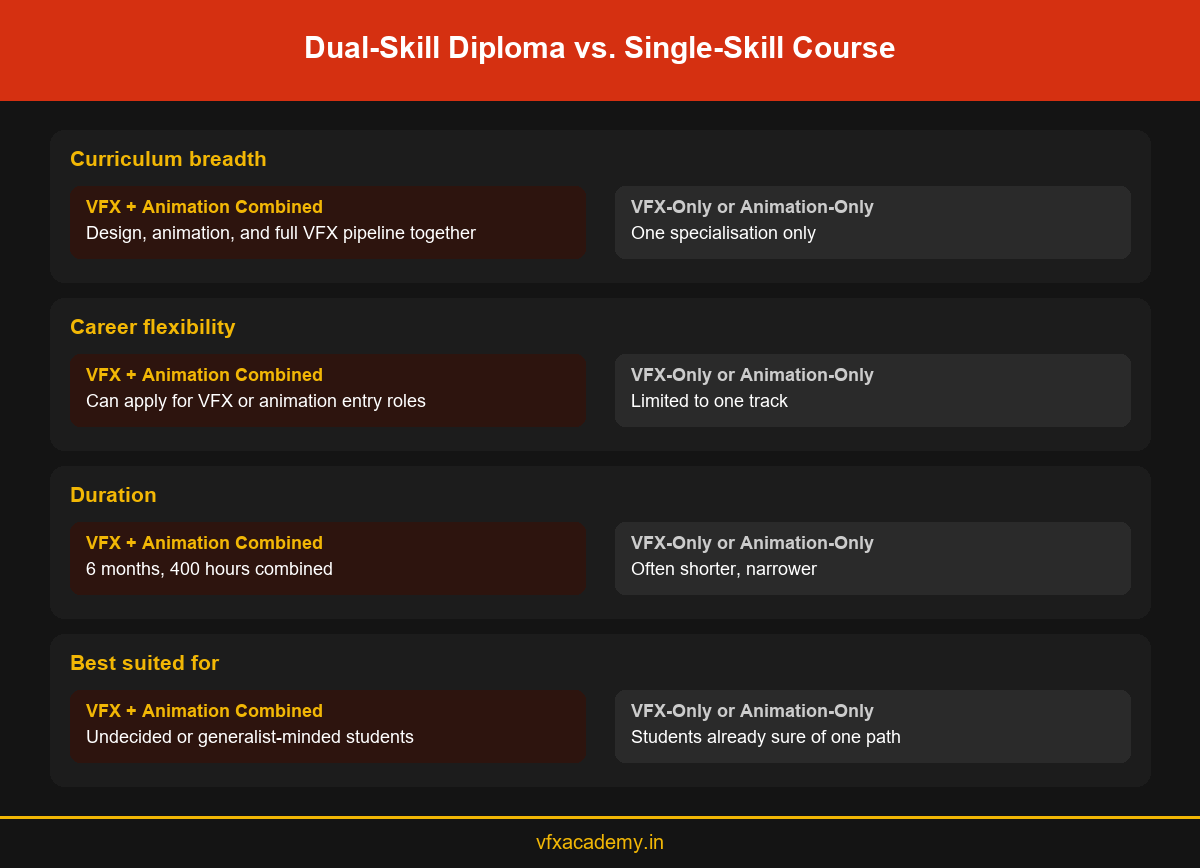
The honest trade-off with any dual-skill diploma is time. Six months split across two disciplines means less depth in each individual skill than a course dedicated entirely to one track. A pure VFX compositing course can spend more total hours inside Nuke; a pure 3D animation course can spend more hours on rigging and character animation specifically.
What the combined format trades in depth, it gains in flexibility. A graduate leaves able to apply for a wider range of entry-level roles, roto artist, junior compositor, junior 3D modeller, motion graphics artist, rather than being locked into one narrow specialisation before they have real production experience to judge which one suits them best.
This is worth weighing honestly against your own certainty. If you already know, with real conviction, that you want to specialise in compositing and nothing else, a single-track VFX course may get you there with more concentrated hours. If you are still deciding, the combined format keeps more doors open.
Who Actually Benefits From the Combined Format
Students straight out of 12th who have creative interest but no fixed specialisation yet tend to benefit most from a combined course. So do career changers who want to explore which side of the pipeline, asset creation or post-production, suits their working style before committing further.
Self-taught creatives who already have some animation or editing experience sometimes find the combined format redundant in the areas they already know, but valuable in the areas they don’t. In that case, it’s worth discussing your existing skill level directly with the academy before enrolling, since pacing through familiar modules can sometimes be adjusted.
Parents evaluating this decision on behalf of a student should weigh the same trade-off from a risk perspective: a combined diploma reduces the risk of a student committing to the wrong single specialisation too early, at the cost of slightly less depth in any one skill by the end of the course.
How to Decide Between Combined and Single-Track Training
Ask yourself three questions. Do you already know which side of the pipeline you want to work in? Do you want the widest possible range of entry-level job applications after 6 months? Are you comfortable with slightly less concentrated depth in exchange for that flexibility? Answering these honestly points most students toward the right format faster than comparing syllabus line items alone.
It also helps to look at outcomes rather than course titles. Ask any institute offering a combined course exactly how many hours are spent on animation-specific work versus VFX-specific work, and compare that split against your own priorities. For more on how Rays VFX Academy structures this balance, see Diploma in Animation and Multimedia: Full Course Guide.
Conclusion
A combined 3D animation and VFX course is worth it for students who value flexibility and are not yet locked into one specialisation, and less ideal for students who already know they want maximum depth in a single track. Rays VFX Academy’s 6-month, 400-hour dual-skill diploma is built to keep both paths genuinely open. Book a free demo class to see how the modules balance animation and VFX training in person.
People Also Ask
Is a combined 3D animation and VFX course better than a single-skill course?
Neither is universally better. Combined courses offer broader career flexibility; single-skill courses offer more concentrated depth in one specialisation.
How long does a dual-skill VFX and animation diploma take?
Rays VFX Academy’s combined course runs 6 months across 400 hours, covering both animation fundamentals and VFX-specific compositing modules.
Will a combined course make me equally skilled in both areas?
You will be competent in both, but depth in each individual skill is generally less than a course fully dedicated to just VFX or just animation.
Who should choose a combined 3D animation and VFX course?
Students who are undecided between the two specialisations, or who want the widest range of entry-level job options after graduating.
Can I specialise further after completing a combined diploma?
Yes. Many graduates use the combined foundation to later focus deeper on either compositing or animation once they have real production experience to guide that choice.
Does Rays VFX Academy offer both combined and single-track options?
The academy’s flagship course is the combined 6-month, 400-hour format. Discuss your specific goals during a free demo class to understand how modules can be weighted.

You may also like
Best 6-Month VFX and Animation Diploma, Explained

Diploma in Animation After 10th: Eligibility and Career Path