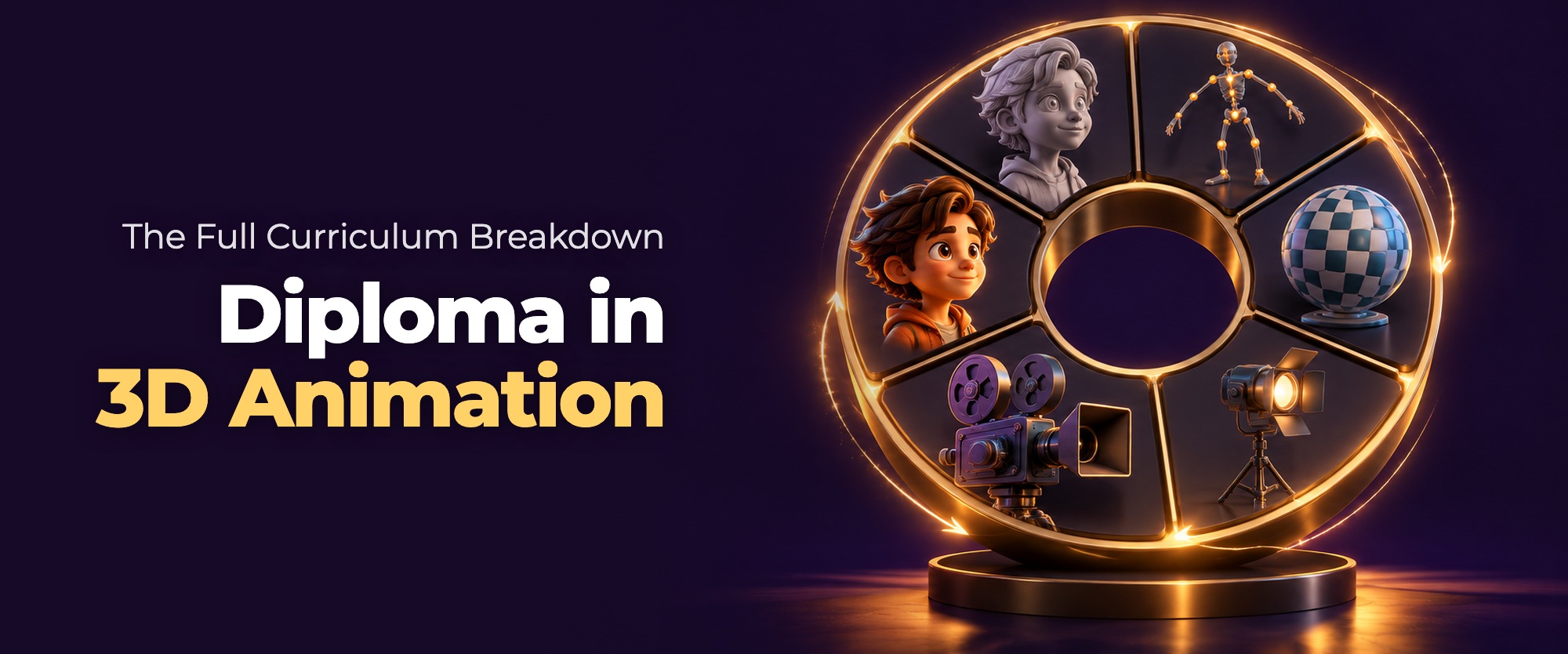
Diploma in 3D Animation: Full Curriculum Breakdown
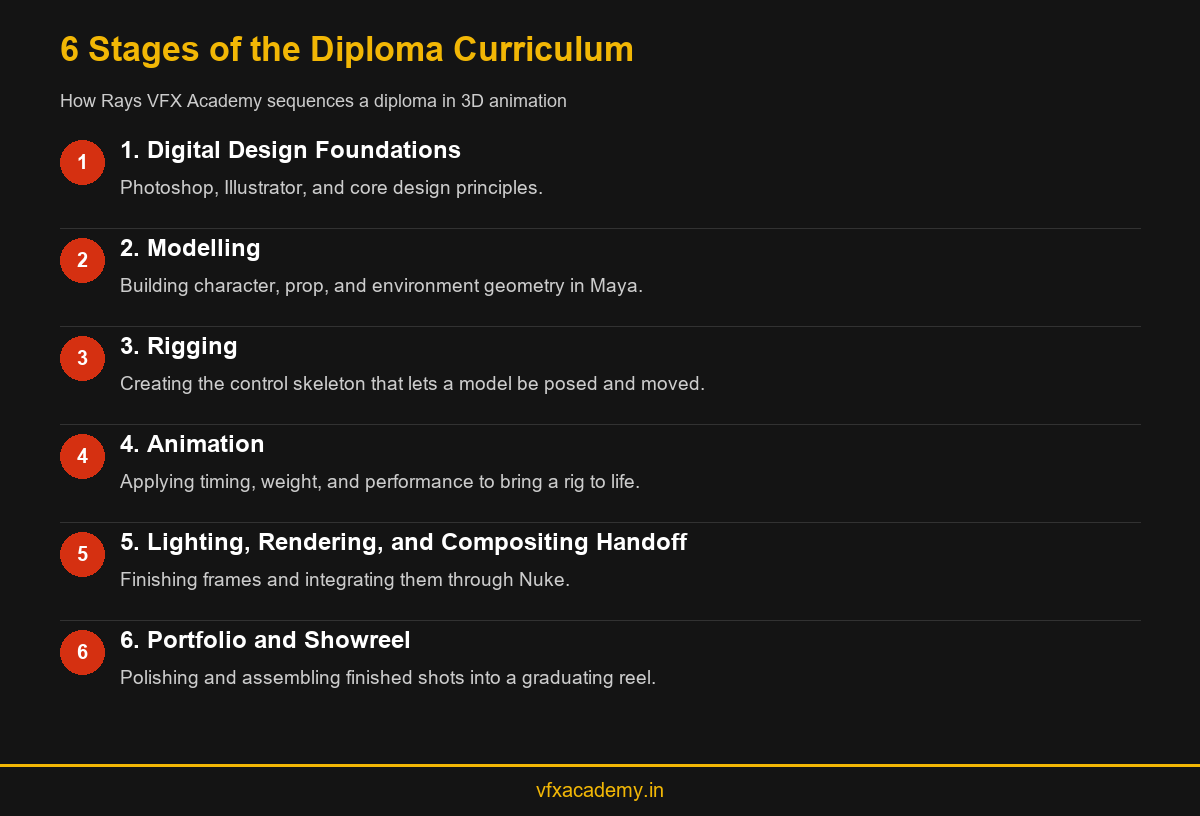
A diploma in 3D animation should be more than a list of software names on a brochure. Understanding how a real curriculum is sequenced, and why that order matters, helps you judge whether an institute’s syllabus reflects genuine production thinking or just a checklist of topics. This guide walks through a full, stage by stage curriculum breakdown, from digital design foundations to the final compositing handoff, based on how Rays VFX Academy’s studio-backed course actually sequences its 6-month, 400-hour training.
Key Takeaways
- A genuine diploma in 3D animation curriculum moves through six connected stages, not a random collection of software lessons.
- Each stage builds directly on the one before it, which is why order matters as much as content.
- Portfolio and showreel work should be built throughout the course, not rushed together in the final weeks.
Stage One and Two: Digital Design Foundations and Modelling
A well sequenced diploma in 3D animation begins with digital design foundations, covering Photoshop and Illustrator alongside basic design principles such as composition and colour theory. These early weeks matter more than students often expect, since texture creation and concept work later in the course depend directly on this foundation.
Modelling follows next, where students learn to build character, prop, and environment geometry using polygons in Maya. This stage rewards patience over speed, since a poorly built model creates avoidable problems in rigging and rendering later in the curriculum. Rays VFX Academy dedicates significant early hours to this stage precisely because shortcuts here compound into larger issues downstream, and instructors regularly review student work at this point to correct small habits before they become entrenched over the remaining months of training.
Students frequently underestimate how much of their final portfolio quality traces back to decisions made during this foundational stage. Clean topology, sensible naming conventions, and efficient UV layouts established early save considerable rework time across every stage that follows.
Instructors who currently work in production, as is the case at Rays VFX Academy through its connection to Rays3D, tend to enforce these habits more rigorously than purely academic instructors, since they have personally experienced the downstream cost of sloppy early work on a real deadline. This practical discipline, more than any single software feature, is what separates a genuinely useful foundational stage from one that merely introduces buttons and menus without context.
Stage Three and Four: Rigging and Animation
Once models exist, rigging adds the internal control skeleton that lets an animator pose and move a character convincingly. This stage is technically demanding, requiring an understanding of how joints, controls, and deformation work together to produce natural looking movement without visible distortion at bend points.
Animation principles, timing, weight, anticipation, and follow through, are then applied on top of a working rig. Students practising this stage move from static poses to full sequences, learning to communicate emotion and intention through movement alone. Reference material and occasional use of motion capture data can support this stage, though hand animation skill remains the foundation most courses prioritise first.
This pairing of rigging and animation is often where students discover which direction their career interest genuinely lies. Some find the technical, problem-solving nature of rigging more engaging, while others connect more strongly with the performance and storytelling side of animation itself. A curriculum that gives fair weight to both stages allows students to make this discovery honestly, rather than being pushed toward one specialisation before they have had a real chance to try each one properly.
Stage Five: Lighting, Rendering, and the Compositing Handoff
Lighting and rendering translate a fully modelled and animated scene into finished frames. Students learn how different lighting setups affect mood and readability, and how render passes can be separated to give a compositor more flexibility during the next stage of production.
This is where the curriculum connects directly to compositing. Rays VFX Academy teaches this handoff explicitly through Maya-Nuke integration and 3D Nuke workflows, so students see exactly how their rendered output gets integrated, graded, and finished rather than treating rendering as the final step of their training.
Stereoscopic pipeline concepts also fit into this stage of the curriculum, giving students exposure to how depth is handled across a wider range of delivery formats. Even students who never work on a stereoscopic project directly benefit from understanding these concepts, since the underlying discipline around render passes and delivery specifications transfers to almost any professional rendering task they encounter later.
Stage Six: Portfolio and Showreel Development
The final stage of a strong diploma in 3D animation curriculum focuses on assembling a coherent portfolio, not producing one rushed piece in the final week. Students revisit earlier assignments, polish weaker shots, and assemble a showreel that demonstrates a complete pipeline understanding rather than isolated, disconnected exercises.
A well built showreel of three or four fully finished shots tends to impress hiring supervisors more than a long reel padded with unfinished tests. Rays VFX Academy structures its final weeks around this principle, encouraging students to prioritise completion and polish over sheer volume of content when preparing their graduating portfolio.
This final stage also often includes guidance on presenting work professionally, correct file naming, sensible reel length, and clear breakdown slides explaining what each student personally contributed to a shot. These presentation habits matter more than students expect when a recruiter is reviewing dozens of portfolios in a limited amount of time and needs to quickly understand what a candidate actually did.
Students who reach this stage having followed the earlier five stages properly usually find portfolio assembly relatively smooth, since most of the underlying work already exists in some form. Students who rushed earlier stages, by contrast, often discover gaps only at this point, which is another reason a curriculum’s early weeks deserve as much attention as its final ones.
How This Curriculum Compares to Other Diploma Programs
Many diploma in 3D animation programs cover similar stage names but spend wildly different amounts of time on each one. A program that rushes through rigging in a single week, for instance, is unlikely to produce students who can build reliable, animator-friendly rigs independently. Ask any institute for an hour by hour breakdown of each stage before assuming two similarly titled programs are comparable. It is also worth asking how a program supports students who progress at different speeds, since rigging and animation in particular are stages where confidence varies significantly within the same batch, and rigid, one-pace teaching can leave slower students behind while others move ahead unsupervised.
For students comparing this curriculum against broader diploma formats, our Diploma in Animation: Programs, Duration, and Career Scope cluster covers how duration and structure vary across the wider market, and our full 3D Animation Course and Diploma guide places this curriculum breakdown inside the wider context of choosing between formats.
Rays3D’s own history, including its 2015 Kerala Government honour and Lumiere Award for Technology, gives families a way to verify the studio lineage behind this specific curriculum rather than relying on course descriptions alone. Asking to see this curriculum broken down hour by hour during a free demo class remains the most reliable way to confirm it matches what is described here before enrolling.
Conclusion
A genuine diploma in 3D animation curriculum moves through six connected stages, digital design, modelling, rigging, animation, rendering, and compositing handoff, each building on the one before it. Rays VFX Academy’s studio-backed course sequences this training around a real production pipeline rather than a random list of software lessons, giving students a clear map of what to expect before they commit to a full 6-month program. Book a free demo class to see this curriculum in action before you enrol.
Frequently Asked Questions
What are the main stages of a diploma in 3D animation curriculum?
The core stages are digital design foundations, modelling, rigging, animation, lighting and rendering, and the compositing handoff, followed by portfolio development.
How long does a diploma in 3D animation curriculum take to complete?
Duration varies by institute, from one to three years for traditional diplomas. Rays VFX Academy covers comparable curriculum depth in 6 months across 400 hours.
Why does modelling come before rigging in the curriculum?
Rigging depends on clean, well built geometry. Poor modelling creates problems that are much harder to fix once rigging and animation work has already begun.
Is portfolio building included in a diploma in 3D animation?
Yes, in a well structured curriculum. Portfolio work should be built throughout the course, with the final stage focused on polishing and assembling a coherent showreel.
Does the curriculum include compositing training?
At Rays VFX Academy, yes. The curriculum connects rendering directly to compositing through Maya-Nuke integration and 3D Nuke workflows rather than stopping at rendering.
Can I skip the modelling stage if I already know Blender?
Prior Blender experience helps, but instructors typically still review modelling fundamentals to ensure consistent, production-ready habits before moving into rigging.
What happens if I fall behind during a technical stage like rigging?
Ask any institute directly how they support students who fall behind, since rigging and animation build heavily on prior stages and gaps compound quickly without support.
How does this curriculum compare to a combined animation and VFX diploma?
It follows similar core stages but connects them explicitly to compositing. See Diploma in Animation and Multimedia for a broader multimedia comparison.

You may also like
3D Animation Design: Skills, Software, and Tools You’ll Master
2D vs 3D Animation Courses: Which Should You Choose